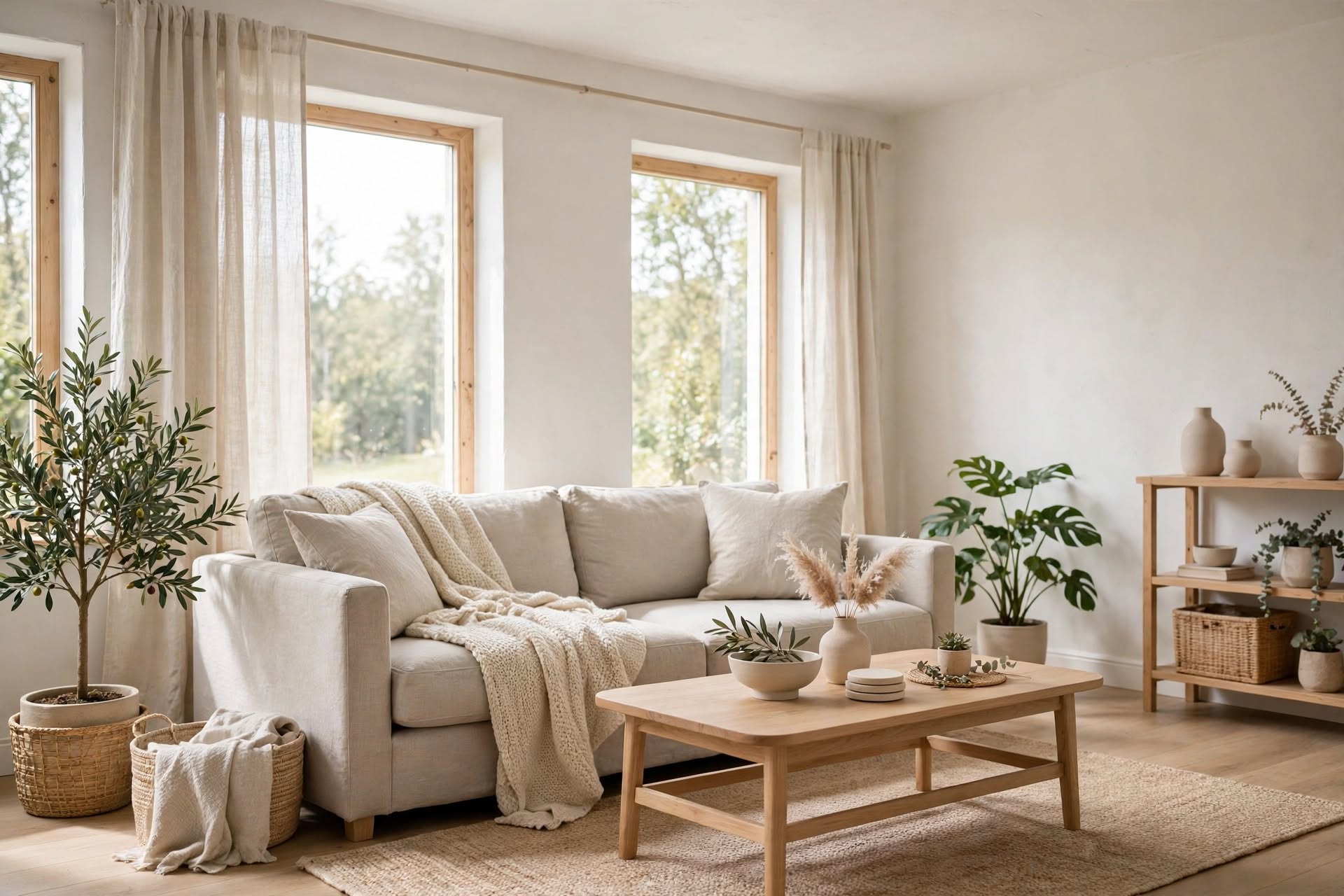

Scandinavian living rooms have a particular kind of appeal. They feel bright without being cold, minimal without looking empty, and comfortable without becoming cluttered. Nothing seems to be fighting for attention. The furniture has room to breathe, natural materials bring warmth, and even the simplest corners feel considered.
But Scandinavian design is not simply a white sofa, pale wooden floors, and a few carefully placed plants. Its real strength lies in balance: between simplicity and comfort, natural light and soft lighting, clean lines and inviting textures.
The goal is not to make a living room look like a furniture showroom. It is to create a space that supports everyday life while remaining calm and visually appealing.
These 19 Scandinavian living room ideas show how to bring that feeling into your home, whether you are decorating a spacious open-plan room or trying to make a small apartment feel lighter and more welcoming.
1. Choose a Soft Neutral Color Palette
A calm Scandinavian living room often begins with a restrained color palette. Warm white, ivory, oatmeal, beige, soft gray, and pale greige create a light foundation without making the room feel sterile.
Pure white can sometimes look too sharp, especially in rooms with limited natural light. A warmer shade with subtle cream or beige undertones usually creates a softer atmosphere.
You do not need to use the same color everywhere. Instead, build a palette with a few related tones:
- Walls: warm white, soft ivory, or pale greige.
- Large furniture: oatmeal, stone, light gray, or muted beige.
- Textiles: cream, charcoal, taupe, or dusty blue.
- Accents: black, muted green, terracotta, or natural wood.
The secret is not to eliminate contrast. A room made entirely of similar pale shades can look flat. A dark frame, a charcoal cushion, or a deeper wooden surface gives the eye somewhere to rest.
Scandinavian design is not minimalism without personality. It is simplicity with enough warmth to feel human.
2. Make Natural Light the Main Feature
Natural light is one of the most valuable elements in a Scandinavian-inspired living room. Large windows, uncluttered window areas, and light-colored surfaces help a space feel open and connected to the outdoors.
If your room has attractive windows, avoid covering them with heavy curtains unless privacy, light control, or insulation makes them necessary.
For a softer look, consider:
- Sheer curtains that filter daylight.
- Light linen curtains that frame the window.
- Simple roller blinds for a clean appearance.
- Wooden or fabric blinds when more privacy is needed.
In a room with limited daylight, keep bulky furniture away from the brightest part of the window when possible. Pale walls, reflective surfaces, and a carefully positioned mirror can also help distribute light.
The aim is not to make every Scandinavian living room look like it belongs in a bright Nordic summer. It is to make the most of the light the room actually receives.
3. Introduce Natural Wood
Natural wood is one of the easiest ways to make a neutral living room feel warm and grounded.
Pale oak, ash, birch, and pine work particularly well with Scandinavian interiors. They bring texture and subtle variation without overpowering the room.
You can introduce wood through:
- A coffee table.
- A sideboard or media cabinet.
- Dining or occasional chairs.
- Open shelving.
- Picture frames.
- Wooden floorboards.
There is no need to use only one wood tone throughout the room. Different finishes can work together when they share a similar undertone or when one finish is repeated in several places.
For example, a pale oak coffee table can sit comfortably beside slightly darker wooden frames if the rest of the palette remains coordinated.
Think of wood as a natural color in the room rather than a material that must match perfectly.
4. Layer Different Textures
A neutral living room can become surprisingly dull when every surface is smooth and every fabric looks the same.
Texture adds depth without requiring bright colors or excessive decoration.
Try combining:
- A wool or jute rug.
- A linen sofa or cotton upholstery.
- A chunky knitted throw.
- Soft wool or bouclé cushions.
- A ceramic vase with a matte finish.
- A wooden coffee table.
- A woven basket for blankets.
The contrast between these materials creates visual interest while keeping the overall design quiet.
A useful approach is to mix textures with different qualities: something soft, something rough, something smooth, and something natural.
For example, a linen sofa, a thick wool rug, a wooden table, and a ceramic lamp can make a simple beige living room feel layered and complete.
5. Choose a Simple, Comfortable Sofa
The sofa is often the largest piece of furniture in the living room, so its shape and color have a major influence on the entire space.
Scandinavian-inspired sofas tend to have clean silhouettes, practical proportions, and comfortable upholstery. They do not need elaborate details to look inviting.
Good options include:
- A simple sofa with slim wooden legs.
- A low-profile design with gently rounded edges.
- A neutral fabric sofa with removable cushions.
- A compact two-seater for a smaller living room.
- A modular sofa when the room needs a flexible layout.
Cream, beige, gray, and muted taupe are versatile choices. However, a soft olive or dusty blue sofa can also work beautifully if the surrounding colors remain balanced.
Before choosing a sofa, measure the room and consider the walking paths around it. A beautiful sofa that blocks the doorway or overwhelms the space is not a successful design choice.
Comfort matters just as much as appearance. A living room should invite people to sit down, not make them afraid to disturb the styling.
6. Use Layered Lighting
One ceiling light rarely creates the warm atmosphere associated with Scandinavian interiors.
A more flexible approach is to combine several sources of light at different heights.
Consider using:
- A ceiling pendant for general illumination.
- A floor lamp beside the sofa.
- A table lamp on a sideboard.
- Wall lights near a reading corner.
- Small accent lights to highlight artwork or architectural details.
Choose warm-toned bulbs for a cozy evening atmosphere, while making sure the light is bright enough for everyday activities.
Lighting fixtures can also become decorative features. Simple glass pendants, understated metal lamps, and sculptural ceramic bases work particularly well with natural materials.
The important thing is flexibility. A room should have enough light for reading, relaxing, entertaining, and moving around safely without relying on one harsh overhead source.
7. Add One Statement Plant
Plants bring life into a Scandinavian living room and create a natural connection between the interior and the outdoors.
Instead of filling every available surface with small pots, consider choosing one larger plant that gives the room a clear focal point.
Depending on the available light and space, suitable options may include:
- A rubber plant.
- A monstera.
- A tall dracaena.
- A fiddle-leaf fig.
- A large indoor palm.
The right plant depends on the room’s light, temperature, and care conditions. Check its needs before choosing a location, particularly if the room receives little direct sunlight.
A simple ceramic planter, woven basket cover, or understated stone-colored pot will help the plant fit naturally into the interior.
If a large plant is not practical, a smaller group of two or three plants can create a similar effect without making the room feel crowded.
The aim is to introduce greenery with intention, not turn the living room into a greenhouse.
8. Make the Fireplace a Focal Point
A fireplace can give a Scandinavian living room a natural center. Its presence adds architectural character and makes the seating arrangement feel more intentional.
A traditional fireplace with a simple surround works well in a classic interior. More contemporary rooms may suit a clean-lined insert, a minimalist stove, or a discreet built-in design.
If the room has a fireplace, keep the surrounding decoration relatively restrained:
- A simple mirror above the mantel.
- One or two ceramic objects.
- A small arrangement of branches.
- A neutral artwork.
- A neatly stored basket of firewood, where appropriate.
You do not need a working fireplace to create this visual effect. A decorative architectural feature, a low console, or a carefully styled wall can provide a similar focal point.
For a real fireplace or stove, follow the manufacturer’s installation and clearance requirements. Decorative simplicity should never come at the expense of fire safety.
9. Choose Minimalist Wall Art
Scandinavian wall art often adds character without dominating the room.
Abstract prints, understated landscapes, botanical illustrations, line drawings, and simple photography can all work well with a neutral interior.
The artwork does not need to match the sofa or rug exactly. It should simply feel connected to the room through color, scale, or subject.
A few approaches to consider:
- One large print above the sofa.
- A pair of coordinated artworks.
- A small gallery wall with consistent frames.
- A muted landscape that introduces a little color.
- Black-and-white photography for a more graphic look.
Pay attention to scale. A very small picture above a large sofa can look lost, while an oversized arrangement may overwhelm a compact room.
Choose artwork that adds something meaningful to the space. Minimalism does not mean that every wall must be empty. It means that the things you display have a reason to be there.
10. Combine Open and Closed Storage
Open shelving looks attractive in photographs, but everyday living creates objects that need somewhere to go.
Books, remote controls, chargers, paperwork, toys, and other small items can quickly make a living room feel cluttered.
A practical Scandinavian interior balances open display with closed storage.
Use closed cabinets for items you do not want permanently visible. Reserve open shelves for books, a few decorative objects, framed photographs, and pieces that contribute to the room’s character.
Useful storage options include:
- A low wooden sideboard.
- A media cabinet with concealed compartments.
- Built-in shelves with closed lower cabinets.
- Storage ottomans.
- Woven baskets for blankets and everyday accessories.
Think about how often you use each item. Things used every day should be easy to reach, while occasional items can be stored out of sight.
A calm room does not require owning fewer things at all costs. It requires giving the things you own a sensible place.
11. Ground the Room with a Natural Rug
A rug helps define the seating area and brings softness to a room with wooden or hard flooring.
In a Scandinavian living room, natural-looking materials and restrained patterns are especially effective.
Consider:
- A wool rug in a warm neutral shade.
- A flatweave rug with a subtle geometric pattern.
- A jute rug for natural texture.
- A soft cream rug for a lighter appearance.
- A muted striped design for gentle visual interest.
Size is important. A rug that is too small can make the furniture arrangement look disconnected.
Ideally, the front legs of the main seating pieces should sit on the rug, when the room layout allows. In a small room, a smaller rug can still work if it clearly anchors the coffee table and seating area.
Choose the material according to how the room is used. A delicate pale rug may be beautiful, but a family living room with pets or frequent foot traffic may need something easier to clean.
12. Create a Cozy Reading Corner
A Scandinavian living room does not have to be designed entirely around the sofa.
A small reading corner can make the space feel more personal and give an unused area a clear purpose.
All you need is:
- A comfortable armchair.
- A floor or table lamp.
- A small side table.
- A soft throw.
- A place for a book or magazine.
Choose a chair that fits the scale of the room. A bulky armchair may overwhelm a small corner, while a compact upholstered chair or a simple wooden lounge chair can feel more appropriate.
If there is a window nearby, position the chair to make use of natural daylight without blocking access or circulation.
Even a narrow corner can become useful with a small chair and a wall-mounted reading light.
The best reading corners do not need much decoration. Their appeal comes from being comfortable and easy to use.
13. Add Muted Accent Colors
A Scandinavian living room does not have to be completely neutral.
Soft accent colors can make the space feel more individual while preserving its calm character.
Some combinations worth considering include:
- Sage green and warm white: fresh and natural.
- Dusty blue and pale oak: quiet and slightly coastal.
- Terracotta and oatmeal: warm and earthy.
- Charcoal and ivory: simple with stronger contrast.
- Muted mustard and gray: subtle warmth without excessive brightness.
Introduce accent colors through cushions, artwork, ceramics, blankets, or a single upholstered chair.
If you are unsure which color to choose, start with a small accessory rather than committing to a large piece of furniture or a painted wall.
A restrained palette does not mean avoiding color. It means choosing colors that work together instead of competing for attention.
14. Style the Coffee Table Simply
The coffee table is one of the easiest places to add personality to a Scandinavian living room.
However, it is also an area that can become cluttered quickly.
Instead of filling the entire surface, use a small arrangement of objects with different shapes and textures.
For example:
- A low ceramic bowl.
- A small stack of books.
- A simple vase with seasonal branches.
- A candle in a restrained holder.
- A wooden or stone tray.
A tray helps keep smaller items together and makes it easier to clear the table when you need more space.
Leave enough empty surface for everyday use. A coffee table should still have room for a cup, a book, or something that belongs to daily life.
The most successful styling feels natural rather than overly arranged.
15. Use Mirrors to Reflect Light
Mirrors can make a living room feel brighter and visually more spacious, particularly when the room has limited natural light.
A mirror placed where it reflects a window or another bright area can help distribute light across the space.
Scandinavian interiors often suit simple mirror shapes and understated frames:
- A large round mirror.
- A tall rectangular mirror.
- A thin black metal frame.
- A natural wood frame.
- A simple frameless design.
Think about what the mirror will reflect before deciding where to hang it. A mirror facing a cluttered corner may simply make that clutter more noticeable.
In a small living room, a full-length mirror can also add depth while serving a practical purpose.
Mirrors are useful design tools, but they work best when their placement is considered rather than automatic.
16. Keep Furniture Proportional to the Room
Scandinavian design places importance on how furniture works within a space.
A living room does not need more furniture to feel complete. It needs the right pieces in the right proportions.
In a small room, consider:
- A compact sofa with visible legs.
- A round coffee table that is easier to move around.
- Narrow side tables.
- Wall-mounted shelving.
- Furniture with built-in storage.
- A lightweight chair that can be moved when needed.
In a larger room, you can use a bigger sofa, a generous rug, or a second seating area to make the space feel balanced.
Try to preserve comfortable walking routes between doors, windows, and the main seating area. Avoid placing furniture where it interrupts the natural movement through the room.
A little empty floor space is not wasted space. It helps the room feel more open and makes everyday use easier.
17. Choose Soft, Simple Window Treatments
Window treatments should support the atmosphere of the room without becoming its main feature.
Light linen curtains, cotton panels, sheer fabrics, and simple blinds all work well in Scandinavian-inspired spaces.
The best choice depends on the room’s orientation and practical needs.
- Sheer curtains soften strong daylight while maintaining a light appearance.
- Linen curtains add natural texture and a relaxed look.
- Roller blinds offer a clean solution for privacy and light control.
- Lined curtains can be useful when additional insulation or darkness is needed.
Choose a length and hanging style that suit the window and ceiling height. Curtains mounted higher than the window frame can create a sense of height, provided the proportions work with the room.
Avoid adding heavy layers simply because they appear in a design photograph. A window should remain functional and allow the right amount of daylight into the space.
18. Decorate with Handmade and Natural Accessories
Handmade objects bring individuality to a Scandinavian living room.
Ceramics, woven baskets, wooden bowls, linen cushions, and simple glass pieces add character without requiring elaborate decoration.
Look for accessories with natural materials and interesting shapes:
- Handmade ceramic vases.
- Woven storage baskets.
- Wooden serving trays.
- Textured stoneware.
- Wool cushions.
- Simple glass candle holders.
- Small objects made from natural fibers.
These pieces do not need to be expensive or perfectly coordinated. Their appeal often comes from subtle variations in shape, texture, and finish.
A useful approach is to choose a few accessories that complement the room’s materials rather than filling every shelf and surface.
Natural objects make a space feel collected over time instead of decorated all at once.
19. Embrace Functional Minimalism
The final idea brings all the others together: keep what serves a purpose, adds beauty, or makes the room more comfortable.
Functional minimalism is not about creating an empty room. It is about making everyday life easier by reducing unnecessary visual noise.
Before adding another decorative object, ask whether it contributes something to the room. Does it provide storage, improve comfort, add texture, or bring a meaningful detail?
This approach can be especially useful in smaller living rooms, where every piece of furniture and every surface has a greater visual impact.
A practical Scandinavian living room might contain a comfortable sofa, a warm rug, a good reading light, a few books, a plant, and enough storage to keep daily clutter under control.
That can be enough.
The room does not need to look untouched. It needs to feel easy to live in.
How to Create a Scandinavian Living Room in a Small Apartment
Scandinavian design is particularly suitable for small living rooms because it emphasizes light, proportion, and practical furniture.
You do not need a large space or an expensive renovation to achieve the look.
Start with these simple adjustments:
- Use a light, warm wall color. It creates a softer and more open background.
- Choose furniture with appropriate proportions. A compact sofa can be more effective than an oversized sectional.
- Use vertical storage. Wall-mounted shelves and tall cabinets make better use of limited floor space.
- Keep the window area relatively clear. Allow as much natural light into the room as practical.
- Choose a rug that defines the seating area. It helps organize the room visually.
- Use concealed storage. Baskets, cabinets, and storage furniture help control everyday clutter.
- Limit the number of decorative objects. A few carefully chosen pieces can have more impact than many small accessories.
For a studio apartment, a rug, a floor lamp, and a thoughtfully positioned sofa can help separate the living area from the sleeping or dining space without adding physical partitions.
Final Thoughts
A Scandinavian living room is not defined by a particular sofa, a specific shade of white, or a perfectly styled coffee table.
It is defined by the relationship between the elements: natural materials, comfortable furniture, thoughtful lighting, useful storage, and enough space for the room to feel relaxed.
The most successful interiors are not necessarily the most expensive or the most minimal. They are the ones that make everyday routines feel a little easier.
Scandinavian design is not about removing everything until a room feels empty. It is about keeping what matters and giving it room to breathe.