
Art Deco living room ideas are all about confident geometry, rich materials, sculptural furniture, and the kind of glamour that never needs to announce itself twice.
I once walked into a hotel lobby in Miami and stopped breathing. Not because of the heat — though that was considerable — but because the room was a time machine. Emerald velvet chairs with backs like seashells. Walls paneled in dark wood and striped with brass. A geometric black-and-white rug that seemed to vibrate underfoot. A single globe lamp casting pools of amber light onto a chrome side table. I sat in one of those chairs for forty minutes, missed my dinner reservation, and decided that whatever Art Deco was, I needed it in my life.
That evening taught me something I have never forgotten: Art Deco is not just a style. It is a mood. It is confidence in material form.
The good news? You do not need a Miami hotel budget to recreate it. With the right colors, shapes, materials, and a few carefully chosen statement pieces, you can bring the spirit of the 1920s into an ordinary living room — without making it feel like a movie set.
Here is how to create an Art Deco living room that feels glamorous, comfortable, and unmistakably timeless.
3 Mistakes That Make Art Deco Look Like a Costume
Before deciding what to buy, it helps to understand what can make Art Deco go wrong. The style is wonderfully dramatic, but there is a fine line between a sophisticated interior and a room that looks as though a vintage theater costume department exploded inside it.
Mistake 1: Too Much Gold
I have seen living rooms where every surface shone — gold frames, gold lamps, gold side tables, gold throw pillows. The effect was less Gatsby and more pirate cave.
Art Deco uses metallic finishes as accents, not as a theme. Gold and brass should catch the eye at carefully chosen moments rather than compete for attention across the entire room.
The fix: Start with two or three noticeable metallic details. A mirror frame, a lamp base, and the legs of an accent chair are enough to establish the look. You can introduce smaller touches elsewhere, but allow the room to have quieter surfaces too.
Gold is punctuation, not the sentence.
Mistake 2: The Wrong Geometry
Art Deco is built on geometry: chevrons, sunbursts, zigzags, fan shapes, arches, and stepped forms inspired by the architecture of the period.
But adding several unrelated geometric patterns does not automatically create an Art Deco interior. It can simply create visual noise.
The fix: Choose one dominant motif and repeat it thoughtfully. A sunburst mirror might be echoed by the curved back of an armchair, while a geometric rug provides a contrasting pattern underfoot. Keep the shapes related rather than identical.
Symmetry is useful in Art Deco, but it does not mean every object must be arranged in a rigid pair. A balanced room can still have an unexpected chair, an angled lamp, or an asymmetrical arrangement of accessories.
Mistake 3: Velvet Without Structure
Velvet is one of the signature materials of Art Deco, but the fabric alone does not create the look.
A loose, oversized velvet sofa can feel relaxed and contemporary. Art Deco velvet usually appears on furniture with a more sculptural silhouette: curved arms, channel tufting, shell-shaped backs, or elegant tapered legs.
The fix: Look for furniture with a defined shape. A rounded barrel chair, a fan-back armchair, or a sofa with a gently curved profile can bring the period’s sense of drama into the room.
The silhouette matters as much as the upholstery.
[IMAGE 1 — Place a full-width editorial photograph after this introduction to the three mistakes section or directly below the article introduction. Show a complete Art Deco living room with a curved emerald velvet sofa, dark walnut details, brass accents, and a geometric rug. ALT: Art Deco living room with emerald velvet furniture, dark walnut details, brass accents and geometric rug.]
The Art Deco Color Palette: Jewel Tones, Warm Neutrals, and Contrast
Art Deco is comfortable with color. It can be dark and theatrical, but it can also be light, polished, and surprisingly delicate.
The secret is contrast. Rich colors become more effective when they have room to stand out.
The Essential Art Deco Colors
| Color family | Popular shades | Where to use them |
|---|---|---|
| Jewel tones | Emerald, sapphire, ruby, deep teal | Accent chairs, sofas, curtains, cushions |
| Dark neutrals | Charcoal, black, midnight blue | Feature walls, cabinetry, large furniture |
| Warm neutrals | Cream, ivory, taupe, champagne | Walls, upholstery, ceilings, rugs |
| Metallic accents | Brass, gold, bronze, chrome | Lighting, mirror frames, furniture details |
| Soft accents | Dusty rose, muted peach, pale jade | Artwork, cushions, smaller decorative pieces |
You do not have to use every color. Choose one dominant palette and build around it.
Dark and Dramatic Art Deco
For a more theatrical interpretation, combine charcoal or deep navy walls with emerald velvet, dark wood, and warm metallic details.
This palette works particularly well in rooms with good natural light, high ceilings, or enough space to accommodate substantial furniture.
If the room is small, consider using the darkest color on one feature wall rather than covering every surface. A dark background can make metallic details and jewel tones stand out beautifully, but it should not come at the expense of comfort or visual balance.
Light Art Deco: Glamour Without the Darkness
Art Deco does not have to mean black walls and emerald upholstery.
A lighter interpretation can use ivory walls, cream-colored furniture, champagne metallic finishes, pale marble, and subtle geometric patterns. Add one or two richer accents — perhaps a sapphire cushion, a dark wood console, or a dusty rose armchair.
This approach is especially useful in smaller living rooms, rental properties, and homes where a dramatic dark palette would feel overwhelming.
The result is softer than traditional Art Deco, but it still has the defining ingredients: symmetry, polished materials, sculptural forms, and deliberate detail.
A Simple Color-Balance Formula
The familiar 60-30-10 decorating rule can be a useful starting point:
- 60% dominant color: walls, flooring, or the largest furniture pieces.
- 30% secondary color: upholstery, curtains, rugs, and other substantial elements.
- 10% accent color: metallic finishes, cushions, artwork, and decorative accessories.
For a dark Art Deco room, the dominant color might be charcoal. For a lighter interpretation, it could be warm ivory.
Treat these proportions as a guide rather than a strict formula. The right balance depends on the room’s natural light, size, and existing finishes.
Materials: What Art Deco Actually Feels Like
Art Deco is a style you should almost be able to feel through a photograph. It combines smooth surfaces, tactile fabrics, reflective finishes, and strong architectural shapes.
The contrast between materials is what gives the room depth.
Velvet: The Signature Fabric
Velvet is an obvious choice for an Art Deco accent chair, sofa, or ottoman. Emerald green is a classic option, but sapphire blue, burgundy, deep teal, and warm ochre can work beautifully too.
Use velvet where it can become a focal point. A single sculptural armchair may have more impact than several upholstered pieces competing for attention.
Dark Wood: Richness and Structure
Walnut, ebony-toned finishes, and dark stained timber create the depth associated with many Art Deco interiors.
Use them on console tables, side tables, shelving, cabinetry, or wall details. A polished finish can create a glamorous effect, while a satin finish feels slightly more restrained and contemporary.
You do not need dark wood everywhere. A single console or a pair of side tables can provide enough contrast.
Brass, Chrome, and Other Metallic Finishes
Brass brings warmth. Chrome creates a cooler, sharper effect. Bronze and darker metallic finishes can add depth without the brightness of polished gold.
You do not have to choose only one metal for the entire room. Instead, establish a dominant finish and introduce secondary metals in smaller quantities.
For example, brass lighting can work with a chrome-framed mirror if the shapes, proportions, and overall palette feel connected.
Lacquer: The Polished Detail
High-gloss black, cream, or deep-colored lacquer works well on side tables, consoles, trays, and decorative boxes.
It reflects light and gives smaller objects a more finished appearance. Use it selectively, especially if the room already contains several reflective surfaces.
Marble and Stone
White marble with gray veining, black marble, and other richly patterned stones fit naturally into the Art Deco vocabulary.
A marble-topped coffee table, a lamp base, or a small side table can introduce the material without making the room feel overly formal.
The aim is not to fill the room with expensive surfaces. It is to choose a few materials that look intentional together.
10 Art Deco Living Room Ideas That Bring 1920s Glamour Home
Now for the enjoyable part: the furniture, lighting, patterns, and decorative details that turn an ordinary living room into something with a little more personality.
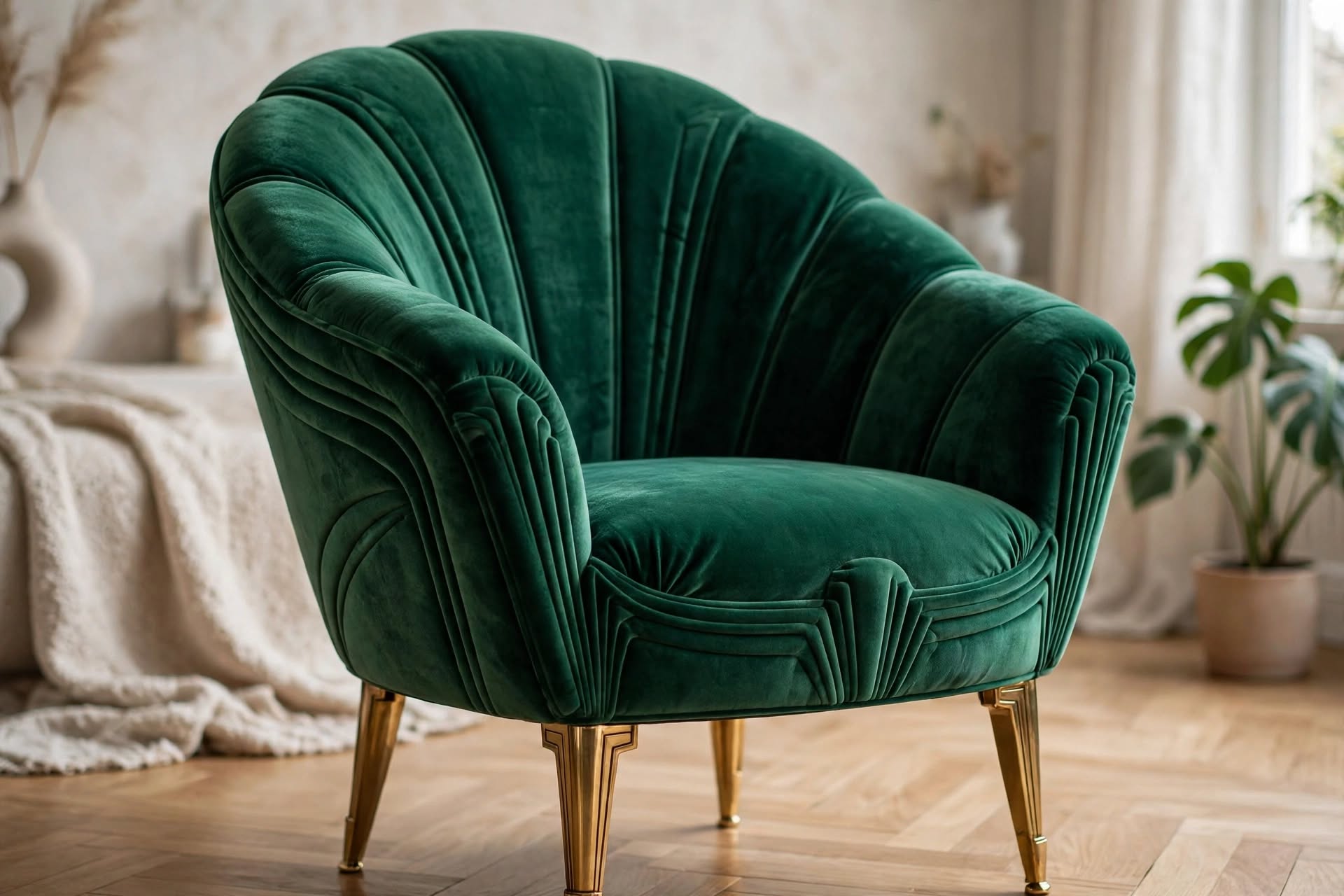
1. Make a Sculptural Accent Chair the Star
Every Art Deco living room benefits from one piece that makes people stop and look. Often, that piece is an accent chair.
Look for:
- Shell-shaped or fan-shaped backs.
- Curved or channel-tufted upholstery.
- Rounded barrel silhouettes.
- Tapered wooden legs or slender metallic legs.
- Velvet or another richly textured upholstery fabric.
Emerald green is an excellent choice, but do not feel obliged to use it. Deep teal, sapphire, burgundy, and mustard can all work when the shape is right.
Pay attention to scale. A large chair can make a wonderful statement, but it should not block walkways or crowd the other seating.
Place it slightly angled toward the sofa or coffee table rather than pushing it flat against a wall. This creates a more inviting conversation area.
[IMAGE 4 — Place directly after this idea. Show a sculptural emerald velvet Art Deco chair with a curved shell back and brass-finished legs. ALT: Emerald green velvet Art Deco accent chair with sculptural shell back and brass-finished legs.]
2. Choose a Geometric Rug That Grounds the Room
A rug is one of the easiest ways to introduce Art Deco geometry without making permanent changes to the room.
Look for:
- Black-and-white chevrons.
- Repeating stepped rectangles.
- Sunburst patterns.
- Fan and shell motifs.
- Symmetrical designs with strong contrasting lines.
The pattern should relate to the rest of the interior. If the walls already have a bold geometric treatment, choose a quieter rug. If the furniture and walls are relatively simple, the rug can carry more visual interest.
Getting the size right: In a seating area, aim for a rug large enough to accommodate at least the front legs of the main furniture pieces. If the room allows, placing all the seating legs on the rug can create an even more unified arrangement.
A rug that is too small can make the furniture look disconnected. Think of it as the stage on which the rest of the room sits.
3. Use Dramatic Lighting to Create Atmosphere
Art Deco lighting is decorative as well as functional. It creates atmosphere through shape, material, and carefully directed light.
Consider three layers:
Ceiling lighting: Globe pendants, stepped chandeliers, frosted glass fixtures, and sunburst-inspired designs can create a strong focal point.
Table lighting: Look for lamps with geometric bases in marble, glass, brass, or lacquer. A sculptural lamp can become a decorative object even when switched off.
Wall lighting: Brass or chrome sconces with frosted glass can add symmetry and create a softer glow around the seating area.
Think about placement before choosing a fixture. A pendant over a coffee table needs a different hanging height from a central ceiling light. It should feel proportionate to the furniture, avoid obstructing sightlines, and allow comfortable movement around the room.
For a warm atmosphere, bulbs in the 2700–3000K range are a good starting point. Choose compatible lighting across the room so that one corner does not look noticeably colder than another.
Art Deco lighting should create pools of warmth, not leave the room too dark to use.
4. Hang a Sunburst or Geometric Mirror
Art Deco loves reflection. A mirror can make a room feel brighter, add depth, and introduce one of the style’s most recognizable decorative shapes.
Popular choices include:
- Sunburst mirrors with radiating metallic details.
- Stepped rectangular mirrors.
- Tall mirrors with curved or fan-inspired frames.
- Round mirrors with bold geometric surrounds.
A mirror above a console or fireplace can create a natural focal point. In a smaller living room, place it where it can reflect daylight or an attractive part of the interior.
Do not choose a mirror based on size alone. Its frame should relate to the furniture and other architectural details in the room.
5. Give the Walls an Architectural Treatment
Walls are an opportunity to introduce the geometry that defines Art Deco.
Consider:
- Symmetrical wall panels.
- Decorative moulding arranged in stepped patterns.
- Geometric wallpaper.
- Vertical fluted details.
- Contrasting paint panels.
- Dark wood or wood-effect feature sections.
For a more traditional look, combine dark wood paneling with metallic details. For a lighter, contemporary interpretation, use cream or muted-colored walls with subtle geometric wallpaper.
You do not need to decorate every wall. A single feature wall behind the sofa can provide enough visual structure.
If you are using wallpaper, look for fan shapes, arches, repeating lines, and stylized botanical patterns rather than generic geometric prints.
6. Choose a Coffee Table With a Sculptural Shape
The coffee table sits at the center of the seating area, so it deserves more attention than it often receives.
Art Deco-inspired options include:
- Round marble-topped tables.
- Black lacquer tables with curved edges.
- Glass tops with metallic frames.
- Stepped rectangular designs.
- Tables with geometric bases.
A round table can soften a room filled with angular patterns. A rectangular design can reinforce a more architectural arrangement.
Think about everyday use as well as appearance. The table should be easy to reach from the sofa, have enough surface space for drinks and books, and leave comfortable room to walk around it.
7. Bring in a Velvet Sofa With a Defined Silhouette
A velvet sofa can become the main statement piece in an Art Deco living room.
Look for gently curved arms, a structured back, channel tufting, or elegant legs. These details create a more distinctive silhouette than a plain box-shaped sofa.
Emerald and sapphire are classic choices, but a cream, champagne, or warm taupe sofa can also work beautifully in a lighter Art Deco scheme.
If the sofa is already bold, keep the cushions relatively restrained. A mixture of velvet, satin-like textures, and subtle geometric patterns can add interest without turning the sofa into a collection of competing decorations.
8. Add Art Deco Artwork and Decorative Objects
Artwork can bring the period’s visual language into the room without requiring a major furniture purchase.
Look for:
- Geometric prints.
- Stylized botanical illustrations.
- Architectural drawings.
- Abstract compositions with strong symmetry.
- Vintage-inspired posters.
- Sculptural objects with stepped or fan-shaped forms.
A large artwork above a sofa can establish the room’s palette. Smaller prints can be arranged in a balanced gallery wall.
For accessories, choose a few objects with interesting shapes and finishes: a geometric vase, a sculptural bowl, a lacquered tray, or a decorative box.
A carefully edited arrangement will usually look more sophisticated than a shelf crowded with unrelated ornaments.
9. Use Curtains and Textiles to Soften the Geometry
Art Deco rooms can contain a lot of hard surfaces and strong lines. Textiles make them more comfortable.
Floor-length curtains in velvet, linen, or another substantial fabric can frame the windows. Choose colors that connect to the room’s main palette rather than introducing an unrelated accent.
Decorative cushions can feature fan motifs, symmetrical patterns, or contrasting piping. A soft throw can make a sculptural sofa feel more welcoming.
The goal is to balance the room’s architectural structure with materials that invite people to sit down.
10. Style a Console Table With Restraint
A console table is a natural place to display a few carefully chosen Art Deco details.
Start with one larger object, such as a mirror or artwork above the table. Then add a table lamp, a sculptural vase, or a small decorative tray.
Try to vary the height and shape of the objects while keeping the arrangement visually balanced.
A stack of attractive books can add color and texture, but choose books you genuinely enjoy displaying. A room should feel curated, not staged for a photograph alone.
[IMAGE 8 — Place after ideas 8–10. Show an Art Deco console with a brass lamp, geometric vase, framed artwork, and a sunburst mirror. ALT: Art Deco console table styled with a brass lamp, geometric vase and decorative mirror.]
How to Design a Small Art Deco Living Room
Art Deco can look spectacular in a large room, but its defining details can work just as well in a compact apartment.
The trick is to use the style’s shapes and materials without filling every available surface.
Choose One Statement Piece
Start with one focal point: a curved velvet chair, a geometric rug, or a distinctive mirror.
Let that piece establish the style. The rest of the room can be simpler.
Use Light Colors Strategically
Cream, ivory, warm beige, and pale taupe can make a small living room feel more open. Add brass details and one or two jewel-toned accents to retain the Art Deco character.
A dark feature wall can still work, especially behind a sofa, but consider how much natural light the room receives.
Choose Furniture With Visible Legs
Furniture raised on slender legs can allow more of the floor to remain visible. This can help a compact room feel less crowded.
A rounded armchair or a sofa with a raised base can introduce the sculptural character of Art Deco without occupying unnecessary visual space.
Use Mirrors and Vertical Details
A large mirror can reflect daylight and make the room feel more spacious. Vertical wall details, tall curtains, and slim lighting fixtures can also draw the eye upward.
Keep Patterns Under Control
A geometric rug or patterned wallpaper may be enough. If both are bold, keep the upholstery and accessories simpler.
Small rooms benefit from clear visual priorities. Give the eye somewhere to rest.
[IMAGE 9 — Place after the small-room section. Show a compact Art Deco living room with an ivory curved sofa, emerald accent chair, brass details, and a geometric rug. ALT: Small Art Deco living room with ivory sofa, emerald accent chair and elegant brass details.]
How to Create an Art Deco Living Room on a Budget
You do not need to replace every piece of furniture to create an Art Deco atmosphere.
Start with what you already own and identify the areas where a few changes would have the greatest impact.
| Design element | Budget-friendly approach |
|---|---|
| Statement chair | Reupholster an existing chair or choose a smaller velvet accent chair |
| Rug | Use a geometric patterned rug to establish the style |
| Lighting | Replace a basic table lamp with a globe or sculptural design |
| Mirror | Choose a sunburst-inspired frame or update an existing mirror |
| Walls | Use paint or removable wallpaper with a geometric pattern |
| Accessories | Add a few brass-finish details and sculptural vases |
| Coffee table | Update the styling of an existing table with a tray and decorative objects |
Prioritize the pieces that are most visible from the entrance to the room. A striking chair, a well-chosen rug, and distinctive lighting can change the atmosphere without requiring a complete renovation.
If you are shopping gradually, begin with the largest item you need. It is easier to coordinate smaller accessories once the main furniture and color palette are established.
Quick Reference: Your Art Deco Shopping List
| Element | What to look for | Budget-conscious option |
|---|---|---|
| Statement chair | Velvet upholstery, curved or shell-shaped back | Compact accent chair or secondhand vintage piece |
| Rug | Geometric, chevron, or stepped pattern | Printed or flatwoven geometric rug |
| Lighting | Globe pendant, frosted glass, sculptural lamp | Decorative table lamp |
| Mirror | Sunburst or stepped frame | Mirror with a metallic-look frame |
| Coffee table | Marble, glass, lacquer, or geometric base | Existing table with a new decorative finish |
| Wall treatment | Paneling, moulding, geometric wallpaper | Paint or removable wallpaper |
| Accessories | Sculptural vases, trays, metallic details | A small, coordinated collection |
Rather than buying everything at once, choose a few pieces that establish the look and add the remaining details over time.
Frequently Asked Questions About Art Deco Living Rooms
What are the main characteristics of an Art Deco living room?
An Art Deco living room typically combines geometric patterns, symmetrical arrangements, sculptural furniture, rich materials, and decorative metallic details. Velvet, dark wood, marble, glass, brass, and chrome are common choices. The overall effect can be dramatic or light, depending on the color palette.
What colors work best in an Art Deco living room?
Emerald green, sapphire blue, burgundy, black, charcoal, ivory, and champagne are all suitable choices. Jewel tones create a more dramatic look, while cream, pale neutrals, and softer metallic finishes produce a lighter interpretation.
Can Art Deco look modern rather than vintage?
Yes. Combine recognizable Art Deco shapes with contemporary furniture, restrained patterns, and a simpler color palette. A curved sofa, geometric rug, sculptural lighting, and a few brass accents can create a modern Art Deco interior without making the room look like a period reproduction.
Is Art Deco suitable for a small living room?
Absolutely. Focus on one statement piece, use a controlled color palette, and avoid overcrowding the room with decorative objects. Mirrors, raised furniture, and carefully scaled geometric patterns can help preserve the style without overwhelming a compact space.
What is the difference between Art Deco and Hollywood Regency?
Both styles enjoy glamour, reflective surfaces, and statement furniture. Art Deco is more strongly associated with geometric forms, architectural symmetry, streamlined silhouettes, and materials such as marble, chrome, and lacquer. Hollywood Regency tends to be more playful and theatrical, often using stronger decorative contrasts and more eclectic combinations.
The Final Toast
An Art Deco living room is not a museum piece. It is an invitation to sit up a little straighter, pour a better drink, and speak in complete sentences.
It says that beauty is not accidental, that geometry does not have to be cold, and that a single emerald chair in a carefully composed room can be worth more than a house full of beige.
You do not need a grand hotel lobby, a dramatic staircase, or a champagne budget. You need a clear palette, a few beautiful shapes, and the confidence to let one or two pieces take the lead.
Choose the velvet. Hang the sunburst mirror. Let the brass catch the afternoon light.
And when your guests walk in and pause at the threshold, you will know: the 1920s never really left. They were just waiting for you to invite them back.