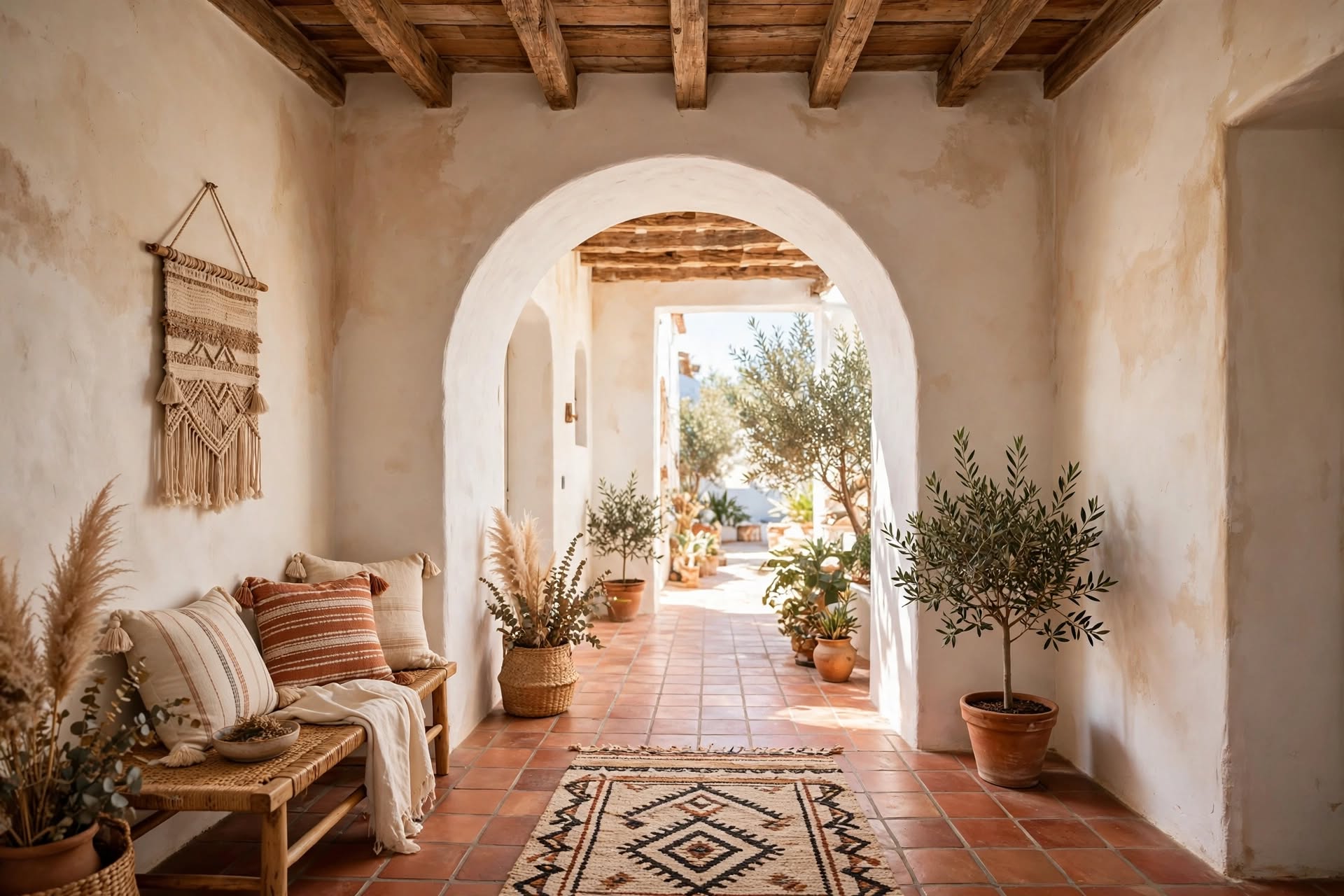

You do not walk through this space simply to get somewhere else.
That is the first lie we must abandon.
You do not enter this corridor with your keys in one hand and your patience in the other, rushing toward the living room, the kitchen, the anywhere-but-here. You enter it because the hallway has staged a coup. It has overthrown its own utility. It has decided to become a destination.
Welcome to the only space in the house that understands anticipation.
A hallway may be narrow. It may have no window, no fireplace, and barely enough room for a console table. But that does not mean it has to feel like a forgotten passage between more important rooms.
With the right combination of architectural details, warm lighting, natural textures, and thoughtful storage, even an ordinary corridor can become one of the most memorable spaces in the home.
In this article, we will explore five boho hallway ideas that bring warmth and personality to a passageway, along with practical ways to make them work in both spacious and narrow homes.
Now, let us turn your corridor into a prologue.
Part I: The Arch Is a Portal You Did Not Order
Look at it.
White plaster curving overhead like a breath held in stone. Wooden beams that have seen seasons you have not. A doorway at the end that looks less like an exit and more like a promise.
An arch changes the way a hallway feels.
A rectangular doorway is straightforward: it connects one room to another. An arch introduces a softer transition. Its curved shape breaks up the straight lines of the corridor and gives the eye something interesting to follow.
In Mediterranean, Spanish, and rustic-inspired interiors, arches often appear alongside plaster walls, natural wood, and terracotta floors. Together, these elements create a sense of age and warmth, even in a relatively simple home.
How to introduce an arch into your hallway
If your home already has an arched doorway, let it become a focal point. Keep the surrounding walls relatively simple so the curve has room to stand out.
If you have a standard rectangular doorway, there are several ways to introduce a similar visual effect:
- Architectural plaster or drywall: A permanent curved opening can be created as part of a renovation. The existing wall construction and doorway structure must be assessed before any alterations are made.
- Decorative arch molding: A curved trim detail can suggest the shape of an arch without rebuilding the opening.
- Painted arch effect: For a simpler decorative approach, a painted semicircle or curved shape above a doorway can create the impression of architectural softness.
- Removable molding: Renters can consider lightweight decorative trim or removable wall treatments, provided they are suitable for the wall finish.
The right approach depends on your home, budget, and whether permanent changes are possible.
A painted arch can be especially effective when its colour is only slightly deeper or warmer than the surrounding walls. The difference creates depth without making the hallway feel visually heavy.
There is no universal arch height or width that works for every doorway. The proportions should follow the existing opening and the architectural details around it.
The goal is not to force a Mediterranean arch into a house that does not want one. It is to introduce a softer shape that feels as though it belongs.
Part II: The Rattan Lamp Is a Sun You Can Touch
Now, look up.
A woven cage of bamboo or rattan, hanging from the ceiling like a lantern that escaped from a festival and decided to stay.
A rattan pendant does more than illuminate a hallway. Its woven surface filters light, creating delicate patterns across nearby walls and ceilings. The result is softer and more atmospheric than the uniform glow of a basic ceiling fixture.
This is why natural woven lighting works so beautifully in boho interiors. It introduces texture even when the rest of the hallway is relatively simple.
Choosing the right hallway light
The most important consideration is not how dramatic the pendant looks in a photograph. It is how comfortably it fits into the actual space.
For a low ceiling or a narrow passage, a flush-mount or semi-flush rattan fixture is often the more practical choice. It provides the woven texture without hanging too far into the walkway.
In a taller hallway, a pendant can create a stronger visual statement, but its lowest point must still leave comfortable clearance for everyone using the corridor.
Before buying, check:
- The total height of the fixture, including its suspension.
- The available ceiling height.
- The width of the hallway and the position of doors.
- The manufacturer’s installation and clearance instructions.
- Whether the fixture is suitable for the intended bulb type and wattage.
The warmth of the bulb matters
For a cozy hallway, warm white lighting is usually a natural starting point.
Bulbs around 2700K create a soft, warm atmosphere, while those closer to 3000K can offer a slightly cleaner appearance without feeling excessively cool.
Brightness depends on the size of the corridor, the number of fixtures, wall colours, and the amount of natural light available. Rather than following one universal lumen formula, consider the total illumination the space needs.
Dimmable lighting can be particularly useful. A brighter setting helps during busy mornings, while a softer evening setting makes the hallway feel more welcoming.
The rattan shade is the sculpture. The light is what brings it to life.
Part III: Fairy Lights Are Constellations on a Budget
String lights.
Draped along a beam, arranged around a doorway, or placed in a loose, gentle line near the ceiling. They bring a little unexpected magic to an otherwise ordinary corridor.
But here is the secret: fairy lights work best when they look intentional.
A carefully arranged strand can add a soft decorative layer to the hallway. Too many strands, however, can make the ceiling feel cluttered and distract from the architecture.
Think of fairy lights as punctuation. They should complement the room, not compete with the main lighting.
How to style fairy lights in a hallway
For a relaxed boho effect, try one of these arrangements:
- Along exposed beams: Follow the natural direction of the timber rather than creating a complicated web of wires.
- Around an architectural detail: A subtle strand near an arch or doorway can emphasize its shape.
- Above a console: A small decorative arrangement can add atmosphere to an entryway corner.
- Inside a lantern: Battery-operated LED lights placed inside a decorative lantern create a gentle accent without requiring visible overhead wiring.
Choose warm white LED string lights for a softer appearance. Their flexibility makes them easier to arrange around architectural details.
Battery-operated versions can be useful when there is no convenient outlet. Some models include timers, which reduce the need to switch them on and off manually.
A note about plants and fairy lights
Trailing greenery can look beautiful alongside decorative lighting, but the arrangement should be planned carefully.
Avoid placing electrical cords where they can become tangled in plant growth or exposed to watering. Keep battery packs and electrical connections accessible and protected according to the manufacturer’s instructions. Do not overload outlets or use indoor-rated lights outdoors.
For a more natural effect, place trailing plants on a high shelf or a securely mounted plant ledge rather than hanging heavy pots directly above a walkway.
The lights should feel like stars. The plants should feel like they grew there naturally.
Part IV: The Rug Is a Road That Leads Nowhere (and Everywhere)
A runner.
Patterned, perhaps, in muted terracotta and cream. Woven from wool, cotton, or jute. Its design repeats, but never quite in the same way.
A hallway rug has a practical job. It softens footsteps, introduces texture, and helps define the length of a passageway.
But it can also tell a story.
A vintage-inspired runner brings colour and movement into a long corridor. A natural flatweave adds texture without overwhelming the architecture. A faded pattern can make a newly decorated hallway feel as though it has always been part of the home.
Choosing the right runner size
The best runner is one that fits the proportions of the hallway while leaving enough visible floor around it.
Measure the width of the passageway first. Then consider how much floor you want to see on either side of the rug.
A runner that is too wide can make a narrow corridor feel crowded. One that is too narrow may look disconnected from the rest of the space.
Length matters, too. The rug does not have to cover the entire hallway. Leaving some visible flooring at the ends can create a more balanced arrangement.
Before buying, also check:
- Whether doors can open freely over the rug.
- Whether the rug thickness is suitable for the space.
- Whether the material can handle the amount of foot traffic.
- Whether the runner is easy to clean.
- Whether a suitable non-slip rug pad is available.
Which material works best?
Wool: A comfortable, textured option with a naturally substantial feel. Wool runners can work particularly well in living areas and lower-mess corridors, although care requirements vary by construction.
Jute and sisal: These materials introduce a strong natural texture. They are less forgiving when exposed to moisture and dirt, so they may be better suited to relatively dry hallways than muddy entryways.
Cotton flatweave: A practical option for busy homes. Many cotton runners are lighter and easier to handle, and some can be machine-washed according to their care labels.
Vintage-style synthetic rugs: These can offer the appearance of a traditional patterned runner with easier maintenance. Check the pile, backing, and cleaning instructions before choosing one.
Never overlook the rug pad
A suitable non-slip rug pad helps keep the runner in place and can make walking across it more comfortable.
Choose a pad designed for your flooring type. Some rubber or latex backings may not be suitable for particular floor finishes, so check compatibility before installation.
A hallway is a place of movement. The rug should invite you to slow down, not make you worry about slipping.
Part V: The Console Table Is a Confessional
Every entryway needs a surface that catches your life as you walk in.
Keys. Mail. Sunglasses. The little things you remove because you are finally home.
A console table gives those objects a place to land. It also creates an opportunity to introduce personality into a hallway without filling the floor with furniture.
In a boho interior, natural wood, woven baskets, handmade ceramics, and soft textiles work particularly well together.
How to style a boho hallway console
On top: Start with a small ceramic bowl for keys, a simple vase, or a carefully chosen decorative object. A candle can add atmosphere, provided it is used safely and never left unattended.
Below: A woven basket can hold scarves, slippers, or other everyday items. If the console has an open shelf, use it to keep practical storage within easy reach.
Above: A round mirror can soften the straight lines of the table and reflect light from the opposite side of the hallway.
The mirror should be positioned comfortably for the people using it. A common starting point is to place its centre near average adult eye level, then adjust according to the mirror’s size, the height of the users, and the surrounding furniture.
Make the mirror work harder
A mirror is especially useful in a narrow hallway because it can reflect light and create a greater sense of openness.
If possible, position it to reflect a window, a bright doorway, or an attractive part of the room.
Avoid placing it where it simply reflects a cluttered corner or an unappealing view. The reflection becomes part of the design, so choose it deliberately.
Add practical wall hooks
A few well-placed hooks can make an entryway much easier to use.
Wooden pegs, antique-style hooks, or simple metal fittings can complement a natural boho palette.
The right height depends on who uses them. If children need to hang their own coats, a lower row can be helpful. In a family home, a combination of adult and child-friendly heights may be more practical than a single decorative line of hooks.
One final rule: leave enough room for coats and bags without narrowing the passageway.
The console should make the hallway feel welcoming, not turn it into a storage obstacle course.
Part VI: How to Decorate a Narrow Hallway Without Making It Feel Smaller
Not every hallway has room for a console, a large pendant, or an impressive architectural arch.
Some are little more than a passage between doors. Others have no natural light at all.
But a narrow hallway does not need more furniture. It needs more thoughtful decisions.
1. Keep the floor visually open
Avoid placing bulky furniture in the walkway. A slim console, shallow wall shelf, or a few wall-mounted hooks can provide useful storage without taking over the floor.
Before choosing furniture, measure the remaining clear passage and check that doors can open comfortably.
2. Use mirrors strategically
A mirror can reflect available light and make a corridor feel more open.
A large mirror is not always necessary. Even a smaller round mirror above a narrow shelf can create a useful focal point.
3. Choose a runner that fits
A runner can visually connect the two ends of the hallway, but it should not overwhelm the floor.
Choose a width that leaves a visible border of flooring and check that the rug does not interfere with doors.
4. Add warmth through texture
When there is little room for furniture, use the walls and smaller details.
Natural wood, woven baskets, textured wall art, ceramic accents, and linen-like fabrics can introduce the boho feeling without taking up valuable floor space.
5. Make lighting part of the architecture
A compact flush-mount fixture, wall sconces, or carefully positioned accent lighting can make a narrow corridor feel more inviting.
If the hallway has no natural light, avoid relying on decorative fairy lights alone. The space still needs adequate general illumination.
The secret is restraint.
A narrow hallway does not need to contain every beautiful thing you have collected. It needs just enough detail to make the journey through it feel intentional.
The 4 Mistakes That Ruin a Cozy Hallway
Even a beautifully styled hallway can lose its charm when the details are not considered carefully.
Here are four common mistakes to avoid.
1. Too Many Competing Light Sources
A rattan pendant, fairy lights, wall sconces, and a table lamp can all look beautiful individually.
Together, they may create too much visual activity.
Choose one main lighting feature and add softer accent lighting where it serves a purpose. The goal is a layered atmosphere, not a ceiling full of competing decorations.
2. A Runner That Does Not Fit the Space
A tiny mat in the middle of a long corridor can look disconnected. A runner that nearly touches both walls can make the hallway feel cramped.
Measure the floor before buying. Leave enough visible flooring around the rug and check that doors can move freely.
3. A Console Table That Becomes a Storage Dump
The bowl, the plant, the candle — that may be all the decoration the surface needs.
Add a practical storage solution below the table if necessary, but avoid allowing the console to become a permanent home for unopened mail, random chargers, and yesterday’s coffee cup.
A little empty space is part of good styling.
4. Choosing Lighting Without Considering the Whole Room
Warm white bulbs can create a comfortable atmosphere, but colour temperature is only one part of the decision.
Consider the wall colour, flooring, natural light, and the other fixtures in the home. A consistent lighting scheme usually feels more harmonious than choosing every bulb independently.
The best hallway lighting makes the space feel connected to the rooms around it.
Epilogue: Live in the In-Between
So here is the truth, delivered with the gentleness of fairy light on white plaster:
Your hallway does not need to be just a hallway.
It can be a sanctuary. A small gallery. A quiet transition between the outside world and the comfort of home.
Hang the rattan lamp. Choose the runner that brings warmth to the floor. Let an arch soften the doorway. Find a place for the keys, the bags, and all the little things that arrive with you.
Let the materials tell their own story: wood that feels warm, woven textures that soften the light, plaster that catches the afternoon sun.
And if the hallway is narrow, do not try to force it into becoming something it is not. Give it room to breathe.
Because the best homes are not defined only by their kitchens or bedrooms. They are also shaped by the spaces in between. The moments of transition. The breaths between sentences.
The hallways that learned to glow.
Now turn on the lights. The stars are waiting.
Happy homemaking.