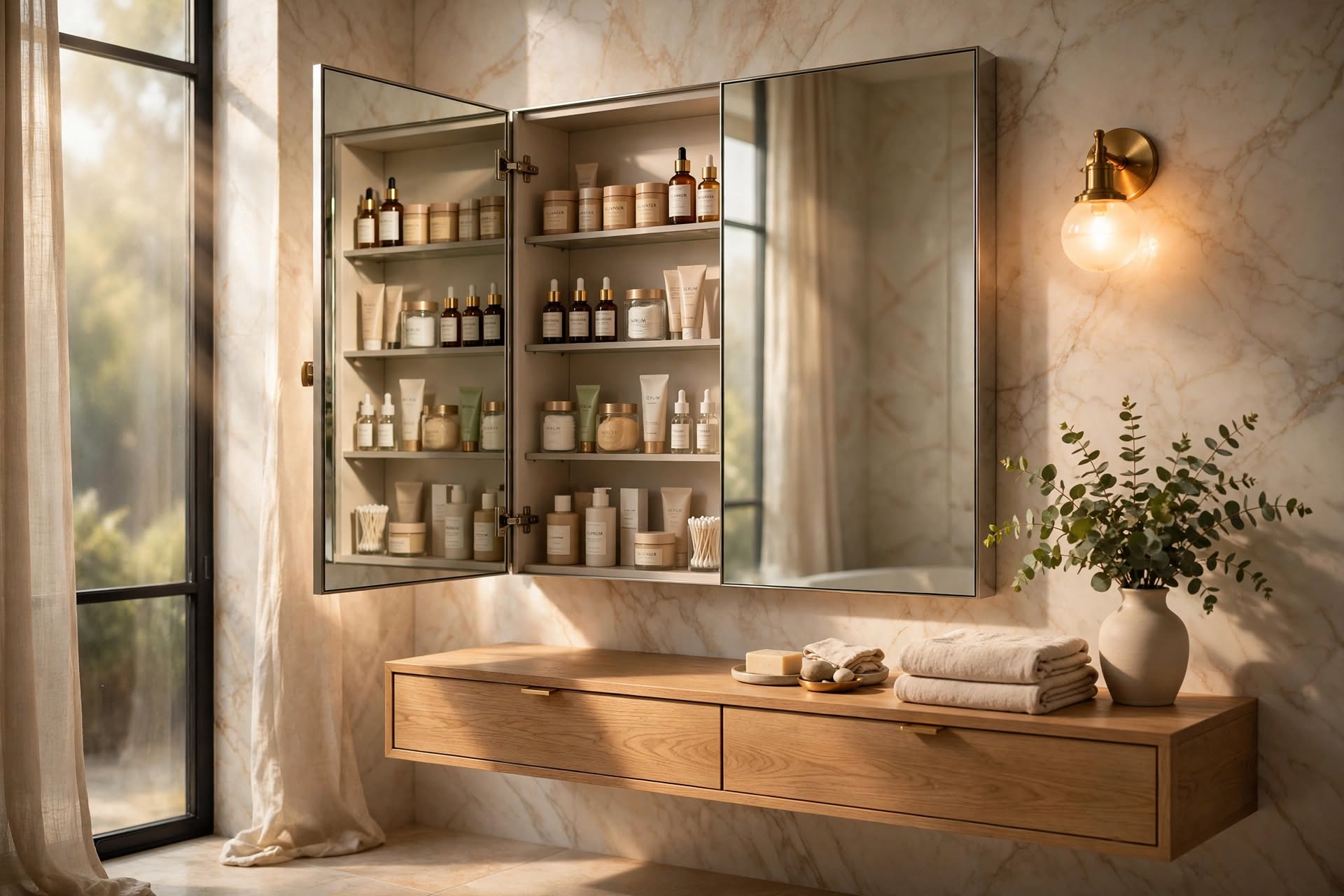
There is a particular moment in the morning when you stand in front of the bathroom mirror and try to remember what you came in for.

Perhaps it is a toothbrush. Perhaps it is the face cream you bought last month. Or perhaps you are simply checking that you still exist before the coffee kicks in.
The bathroom mirror witnesses all of it.
But a beautiful bathroom mirror can do more than reflect your face. It can hide the small necessities of everyday life, bring light into a quiet corner, and make a room feel more considered.
That is the quiet magic of a well-designed medicine cabinet.
It is storage disguised as architecture. A practical little secret behind a reflective surface.
And when chosen carefully, it can become one of the most useful design features in the entire bathroom.
1. The Medicine Cabinet: A Mirror With a Secret
A traditional medicine cabinet has a simple job: keep everyday essentials close without leaving them scattered across the vanity.
A modern one does something more interesting. It makes storage almost disappear.
Recessed medicine cabinets sit partly inside the wall, creating a cleaner, more streamlined appearance than many surface-mounted alternatives. They are especially useful in bathrooms where counter space is limited or where a bulky cabinet would interrupt the visual flow.
But there is one important detail: a recessed cabinet is not automatically suitable for every wall.
Before choosing one, check the available wall cavity and the position of studs, plumbing, electrical wiring, and other structural elements. The actual installation depth depends on what is behind the wall. In some bathrooms, a surface-mounted cabinet is the more practical choice — and a well-designed one can still look elegant.
Choose the right size
The cabinet should feel connected to the vanity beneath it, rather than looking like a small mirror that has been placed there by accident.
A useful starting point is to consider the vanity width, the available wall space, and the overall proportions of the room.
A mirror that is slightly narrower than the vanity can create a balanced, framed appearance. A wider mirror can make a compact bathroom feel more open. Neither approach is automatically better; the right choice depends on the wall, the lighting, and the design you want to achieve.
Also consider what needs to fit inside.
Look beyond the cabinet’s advertised overall dimensions. Check its usable interior depth, shelf spacing, door clearance, and the maximum height of items that need to stand upright. A cabinet can look generous from the outside and still be frustrating when tall bottles cannot fit between its shelves.
The design principle: choose a cabinet that looks like part of the room, but works like a well-organized drawer.
2. Marble: The Stone That Makes the Room Feel Timeless
Marble has a way of changing the atmosphere of a bathroom.
Its natural veining brings movement to an otherwise quiet surface. Its subtle variations make a room feel less manufactured and more personal.
A marble backsplash, vanity top, or full-height stone wall can turn a practical bathroom into something that feels closer to a small private retreat.
One particularly striking option is book-matched marble. This technique places two adjacent stone slabs so their veining forms a mirrored pattern. The result can resemble an abstract painting spread across the wall.
It is a dramatic choice, especially behind a vanity or around a large mirror.
However, book-matched stone requires careful planning. The pattern, slab availability, cutting, and installation all influence the final result. It is worth discussing the layout with the stone supplier and installer before purchasing the material.
Understanding marble care
Marble is a natural stone, but it is not maintenance-free.
It can absorb certain liquids and is vulnerable to acids. Lemon juice, vinegar, and some bathroom cleaning products can dull or etch its surface. A penetrating sealer may reduce absorption and help protect against some stains, but it cannot make marble completely stain-proof or prevent acid etching.
Care requirements depend on the specific stone, finish, sealer, and how heavily the surface is used.
For everyday cleaning, use a cleaner specifically suitable for natural stone, following the manufacturer’s instructions. Avoid acidic household cleaners and abrasive products unless the stone-care professional confirms they are appropriate.
Sealing should also follow the recommendations for the particular stone and product rather than an automatic calendar schedule.
Marble rewards thoughtful care. It does not need to look untouched to look beautiful; its natural character is part of the appeal.
3. The Floating Vanity: A Little Architecture Off the Floor
A floating vanity creates an immediate sense of lightness.
By lifting the cabinet off the floor, it reveals more of the room beneath it. The floor appears to continue uninterrupted, making the bathroom feel more open and less crowded.
It is a particularly useful visual trick in smaller bathrooms, where every uninterrupted line helps.
But a floating vanity is not simply a cabinet with its legs removed.
It needs proper structural support. The wall construction, mounting system, vanity weight, countertop material, and expected load all matter. Installation should follow the manufacturer’s specifications and, where necessary, be handled by a qualified professional.
Finding the right height
There is no single vanity height that works for every bathroom.
A comfortable height depends on the people using the room, the vanity design, and the basin itself. A vessel sink, for example, adds height above the countertop, so the cabinet may need to sit lower than a vanity designed for an integrated basin.
Consider the finished height from the floor to the top edge of the sink — not just the cabinet dimensions.
It is also worth thinking about practical details before installation:
- Will the drawers clear the plumbing?
- Is there enough room for the basin and tap?
- Can the vanity support the selected countertop?
- Is the mirror positioned comfortably above the finished sink height?
- Is the floor underneath easy to clean?
The best floating vanity is not the one that looks most dramatic in a photograph. It is the one that makes the room feel lighter without making everyday use more complicated.
4. Lighting: The Difference Between a Pretty Reflection and a Useful One
A bathroom mirror can be beautiful and still be difficult to use.
The problem is often lighting.
A single overhead fixture may create shadows beneath the eyes and chin. A backlit mirror can add a soft glow around the glass, but that glow is not always enough for detailed tasks such as shaving, skincare, or applying makeup.
The secret is to think about bathroom lighting in layers.
Backlit mirrors for atmosphere
A backlit mirror creates a gentle halo around its edges. It can make the mirror appear to float against the wall and add a soft, contemporary atmosphere.
This type of lighting is particularly effective as ambient or decorative illumination.
However, a halo behind the mirror does not necessarily illuminate the face evenly. Its usefulness as task lighting depends on the design and light output of the specific mirror.
Side lighting for everyday tasks
Wall sconces placed on either side of the mirror can provide more balanced illumination across the face.
Their position should be planned in relation to the mirror’s size, the height of the users, and the shape of the fixtures. There is no universal spacing that suits every bathroom.
If side sconces are not practical, consider a mirror with integrated front-facing task lighting or a suitable combination of mirror lighting and other fixtures.
Choose the right atmosphere
For a comfortable bathroom, look for lighting that renders colours naturally and does not feel harsh. The appropriate colour temperature depends on the overall design and personal preference, but consistency between fixtures is important.
And remember: bathroom lighting must be suitable for the location in which it is installed. Follow electrical safety requirements and use fixtures rated for the relevant bathroom zones.
A mirror should help you see clearly, not just make the room look beautiful after sunset.
5. Five Medicine Cabinet and Bathroom Design Mistakes to Avoid
Even a beautiful bathroom can become frustrating when the small details are overlooked.
These are five common mistakes worth avoiding before the renovation is finished.
Mistake 1: Choosing a mirror that feels disconnected from the vanity
A very small mirror above a wide vanity can make the entire arrangement feel unbalanced.
Before buying, consider the vanity width, available wall space, lighting fixtures, and the visual proportions of the room. Use measurements as a planning tool, not as a universal rule.
Mistake 2: Forgetting the actual storage needs
A medicine cabinet may look spacious in a product photograph, but its interior can tell a different story.
Check shelf spacing, usable depth, door clearance, and the dimensions of the items you intend to store. Adjustable shelves can make the cabinet more flexible.
A few minutes spent measuring can prevent years of rearranging bottles that never quite fit.
Mistake 3: Relying on overhead lighting alone
A ceiling light may illuminate the bathroom, but it can create unflattering shadows at the mirror.
Combine ambient lighting with suitable task lighting. Side sconces or a well-designed front-lit mirror can make daily routines much easier.
Mistake 4: Treating marble as a maintenance-free surface
Marble is beautiful, but it needs appropriate care.
Use products intended for natural stone, avoid acidic cleaners, and follow the recommendations for the specific stone and sealer. Remember that sealing can help reduce staining but does not prevent etching.
Mistake 5: Assuming every bathroom item belongs in the medicine cabinet
The name is familiar, but the bathroom is not always the best place to store every medication.
Humidity and temperature fluctuations can affect certain medicines and products. Always follow the storage instructions on the packaging or provided by a pharmacist. If a medication requires a cool, dry environment, a bedroom cupboard or another suitable location outside the bathroom may be more appropriate.
For items that are suitable for bathroom storage, keep them organized, dry, and out of reach of children.
A beautiful cabinet should make everyday life easier — not encourage unsafe storage habits.
6. Small Bathroom, Smart Storage: Make Every Inch Count
A medicine cabinet becomes even more valuable when the bathroom has limited storage.
The goal is not to fill every available corner. It is to make the space work without making it feel crowded.
A few thoughtful choices can help:
- Use vertical space. A taller cabinet can provide more storage without taking up additional vanity space, provided the wall and proportions allow it.
- Choose adjustable shelves. They make it easier to accommodate products of different heights.
- Keep everyday items accessible. Store frequently used essentials where they are easy to reach.
- Use small organizers. Trays and divided containers help prevent tiny items from disappearing behind larger bottles.
- Keep the countertop edited. Leave only the things used regularly on display.
The most successful small bathrooms do not necessarily contain more storage. They simply make better use of the storage they already have.
7. Bringing the Details Together
A medicine cabinet, marble surface, floating vanity, and carefully planned lighting should not feel like four separate design decisions.
They should work together.
If the bathroom has dramatic marble, a simpler cabinet frame can keep the room from feeling too busy. If the vanity has strong wood grain, understated hardware and a clean mirror can provide balance.
If the room is small, a recessed cabinet and a floating vanity may help preserve a sense of openness. If the bathroom has limited natural light, thoughtful mirror lighting can make the space more welcoming.
Think about the finishes, too.
Warm metals can complement creamy stone and natural wood. Matte black hardware creates a stronger contrast. Chrome and brushed nickel often work well in cleaner, more contemporary schemes.
There is no need to match every finish perfectly. A little variation can make a bathroom feel collected rather than assembled from a single showroom display.
The most important thing is consistency: each element should feel as though it belongs in the same room.
The Mirror Knows More Than It Tells
A medicine cabinet is a small piece of architecture with a surprisingly important role.
It keeps the daily essentials close. It gives the vanity a cleaner appearance. It can bring light into the room and make a small bathroom feel more considered.
And perhaps that is why it deserves more attention than it usually receives.
We tend to think of bathroom design in terms of the big things: the bathtub, the tile, the vanity, the shower. But the details are what make a room comfortable to live in.
A well-chosen medicine cabinet does not ask for attention. It simply opens when needed, closes when finished, and leaves the room looking a little more peaceful.
It sees everything.
And, thankfully, it keeps most of it to itself.