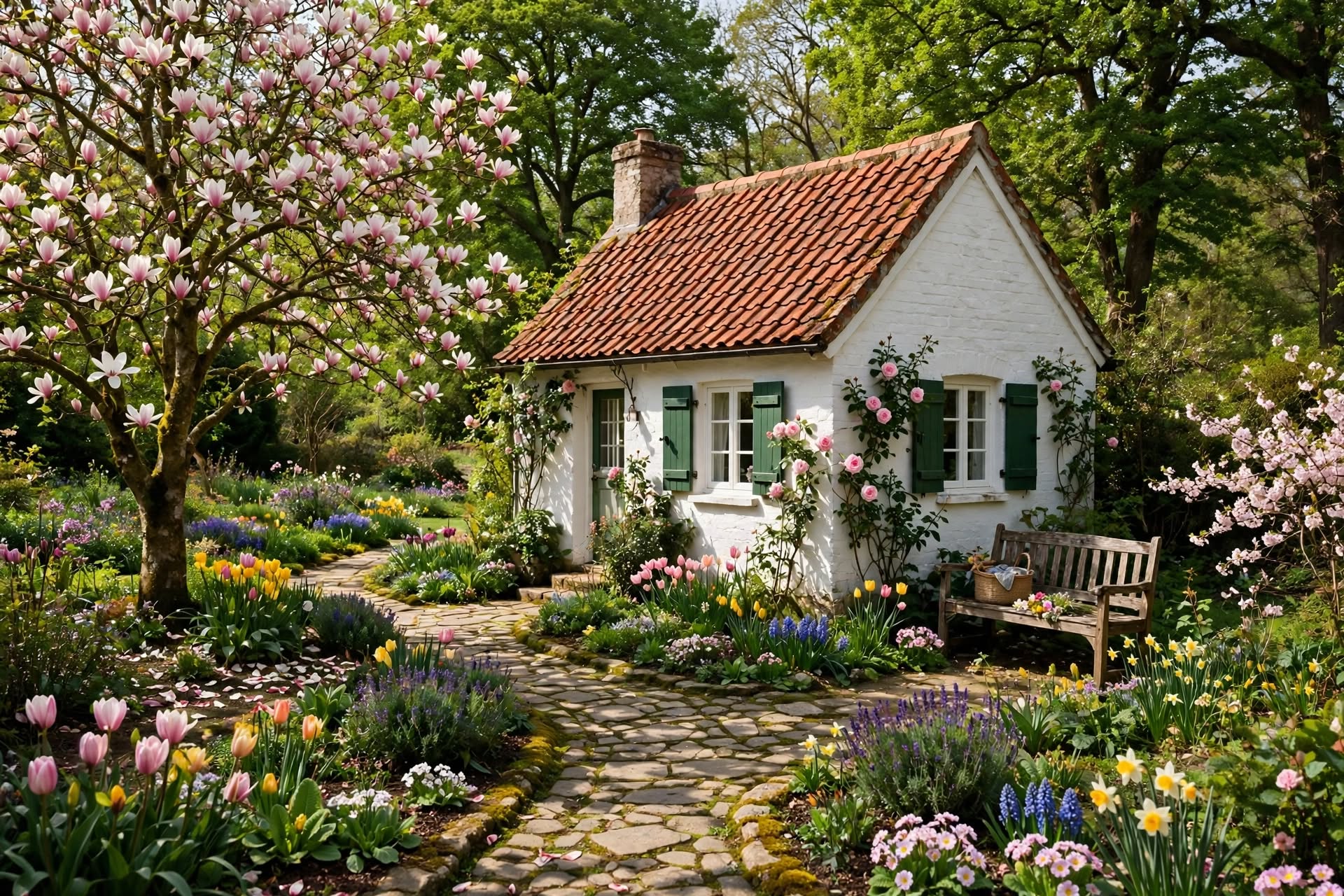

You do not build this house.
You plant it. You water it. You wait twenty years for the magnolia to arch over the roofline like a mother leaning down to kiss a child’s forehead. The house is not the point. The house is simply the excuse the garden needed to exist.
Welcome to the only real estate where square footage is measured in petals.
There is something quietly magical about a small house surrounded by a generous garden. The walls seem softer. The windows look deeper. Even the roof appears to belong to the landscape rather than sit on top of it.
A tiny house does not need a grand entrance or a sweeping driveway to feel extraordinary. Sometimes all it needs is a red-tiled roof, a winding stone path, a wooden bench, and a tree that has been growing longer than anyone can remember.
This is the charm of a garden-first home: a place where architecture makes room for nature, and nature becomes the most beautiful part of the architecture.
Part I: The Roof Is a Hat
Look at it. Terracotta tiles the color of dried paprika. A roof so deliberately red it makes the sky look shy.
Here is the first lie we must unlearn: roofs are only for shelter. Nonsense. This roof is advertisement. It is the garden’s way of saying, “Something interesting lives underneath.” Birds use it as a landmark. Mail carriers slow down. Clouds pause overhead to admire the contrast — white walls, red hat, green everything else.
And there is a small architectural magic in the way a generous roof meets a modest house. Deep, carefully designed eaves can create welcome shade along the walls and shelter a doorway from some of the rain. The roofline gives the house a strong silhouette, while the garden softens everything beneath it.
The overhang becomes a shadow stage where ferns and climbing plants seem to perform. Rainwater travels from the tiles into gutters and downpipes, where it can be collected for the garden if the system is designed for safe drainage and storage.
The slope is calculated by engineers, of course, but the garden gets to enjoy the result. Water falls, the soil drinks, and the hydrangeas wait for their turn.
You did not buy a house. You bought a hat stand for a landscape.
Garden idea: If you love the look of a cottage with a strong roofline, repeat its colors in small details around the garden. Terracotta pots, warm stone, a wooden gate, or a simple red-brown garden feature can connect the house to the landscape without making everything match too perfectly.
Part II: The Bench Is a Throne
A wooden bench, slightly weathered, placed where the morning light lands like a gift.
But here is the twist: this bench is not just for sitting. Not really. It is for witnessing. For holding the weight of someone who needs to remember that time is not actually moving faster — they are just breathing shallower.
The bench does not care about your productivity. It does not sync with your calendar. It asks only that you arrive with empty hands and stay until your shoulders remember their natural position.
The ivy climbing the wall behind it? That is not decoration. That is patience made visible. It takes time for climbing plants to cover a wall, and their growth depends on the species, climate, light, and growing conditions. A mature green wall is not an afternoon project. It is a record of seasons.
The bench collects this patience. It radiates it back to whoever sits down, defeated by a world that moves too fast for wooden benches.
And placement matters. A bench tucked beneath a tree can offer summer shade, while one positioned to catch the morning sun may become the most inviting seat in the garden on a cool day. Before choosing its location, notice where sunlight falls throughout the day and consider the view from the seat itself.
You are not resting. You are receiving a tutorial in permanence.
Garden idea: Give the bench something worth looking at. It might face a flowering border, a small pond, a climbing rose, or simply a quiet patch of lawn framed by shrubs. A beautiful garden seat does not need to be expensive. It needs to feel as though it belongs exactly where it stands.
Part III: The Path Is a River
Stone slabs, irregular, set into earth like islands. A cottage at the end, half-hidden by wisteria and the architectural ambition of tulips.
But forget the idea of simply walking from one place to another. The path is not only for feet. It is for eyes.
Each stone is a stepping stone across a river of color — the blue current of grape hyacinths, the white rapids of cherry blossoms, the yellow eddies of daffodils daring you to look away.
You do not walk to the door. You ford a current of bloom.
And here is the secret that ruins straight concrete walkways forever: a gently curving path can make a small garden feel more spacious by revealing the landscape gradually. You do not see everything at once. A shrub hides part of the view. A flower border opens around the next bend. The destination feels discovered rather than displayed.
Irregular stone adds another layer of character, but it should never come at the expense of a safe walking surface. Choose stones that can be set firmly, keep the walking line reasonably even, and avoid loose pieces that rock underfoot. Moss may look romantic between paving stones, but slippery growth is better kept away from frequently used walking areas.
A straight path says hurry. This path says notice.
It turns a thirty-second walk into a three-minute journey, and in those extra two minutes, you spot the bee in the foxglove, the snail on the lamb’s ear, the single tulip that decided to be orange in a sea of pink.
You are not approaching a house. You are crossing a living watercolor.
Garden idea: For a small cottage garden, use a path that gently bends or changes direction rather than crossing the space like a ruler. Plant low-growing flowers along the edges, leaving enough clearance for comfortable walking. The goal is a sense of discovery, not an obstacle course.
Part IV: The Tree Is the Real Roof
A bench. A tree. A snowfall of petals so thick the grass forgets it is green.
This is where logic completely dissolves. The house has a roof, yes. But the tree has a canopy. And the canopy is alive. It breathes. It drops perfume on your shoulders. It changes color according to moods the meteorologist cannot predict.
In spring, it is pink confetti. In summer, it is a green cathedral. In autumn, it is a bonfire that never burns. In winter, it is a drawing of itself against a gray sky — still beautiful, still holding the space where shade used to be.
The house shelters your body. The tree shelters your soul.
You sit on that bench not to rest from gardening, but to understand why you garden at all. A mature tree changes the feeling of a property. It creates shade, gives birds a place to visit, softens the outline of buildings, and makes even a modest garden feel established.
But choosing a tree for a small garden takes a little thought. A magnolia can be wonderful, but different varieties grow to very different sizes. Consider the mature height and spread, the available root space, the amount of sunlight, and the distance from buildings and paths before planting.
A compact flowering tree may be a better choice for a small plot than a variety that eventually overwhelms the space.
The tree does not need you to admire it. It simply grows, season after season, while the garden changes around it. Your pruning shears do not threaten it. Your mortgage does not impress it. The tree is the true landlord, and you are simply the tenant who pays rent in compost and admiration.
You do not own this garden. You serve it.
Garden idea: Choose one tree to become the visual anchor of the garden. Build the surrounding planting around its shape and seasonal character. A flowering tree, a small ornamental tree, or a carefully selected evergreen can give a tiny garden a sense of permanence.
How to Create a Garden That Makes a Small House Feel Bigger
A garden-first home is not necessarily a large property. It is a place where every outdoor element has a relationship with the house.
The secret is not to fill every corner. It is to make the garden feel connected, layered, and inviting.
1. Let the House and Garden Share a Color Story
A white cottage with a terracotta roof already has a beautiful starting palette. Repeat those warm tones through clay pots, natural stone, weathered wood, and soft-colored flowers.
You do not need to match every detail. A few repeated materials are enough to make the landscape feel connected to the architecture.
2. Plant in Layers
A small garden can feel deeper when plants have different heights.
Use low-growing flowers near the path, medium-height shrubs behind them, and taller plants or small trees toward the back or sides of the garden.
This creates a sense of depth without requiring a large lawn or complicated landscaping.
Remember to check the mature size of every plant. A tiny nursery pot can become a surprisingly large shrub in a few years.
3. Use Vertical Space
When ground space is limited, walls, fences, and trellises become valuable planting areas.
Climbing roses, clematis, and other suitable climbers can soften a wall or frame a doorway. Choose plants according to your climate, the amount of sunlight, and the support they need.
Leave room for maintenance, and make sure climbing plants do not damage gutters, roofing, or vulnerable masonry.
4. Create One Place to Pause
A garden does not need several seating areas to feel generous. One well-positioned bench may be enough.
Place it where you can enjoy a view, a little shade, or a patch of morning sunlight. Add a nearby pot of seasonal flowers if you like, but avoid crowding the seat with decoration.
The bench should feel like an invitation, not another item on a shopping list.
5. Make the Path Part of the Garden
A path should connect the entrance, seating area, and other important parts of the garden without cutting the space into disconnected sections.
Natural stone, gravel, brick, and stepping stones can all work, depending on the style of the house and the amount of maintenance you are prepared to do.
Keep the surface stable and the route comfortable. A beautiful path should make the garden easier to enjoy, not harder to navigate.
Epilogue: Live Small, Bloom Wide
So here is the truth, delivered with the gentleness of petals on stone:
You do not need a bigger house. You need a smaller house with a bigger garden.
You need walls that hold warmth and windows that frame branches. You need a door painted blue so the wisteria knows where to stop. You need a path that forces you to pay attention. You need a bench that holds your stillness without comment.
You need a garden that changes with the seasons, where spring arrives in flowers, summer settles beneath the canopy, autumn leaves a golden carpet, and winter reveals the beautiful structure of branches and stone.
The tiny house that grew a garden first is not a trend. It is a different way of measuring a home.
Not by the number of rooms, but by the places where you want to linger. Not by the size of the roof, but by the tree that reaches beyond it. Not by how much space you own, but by how much life you allow to grow around you.
Plant the magnolia. Paint the door. Place the bench where the light falls.
Then sit down.
The tree is already blooming for you.
Happy gardening.