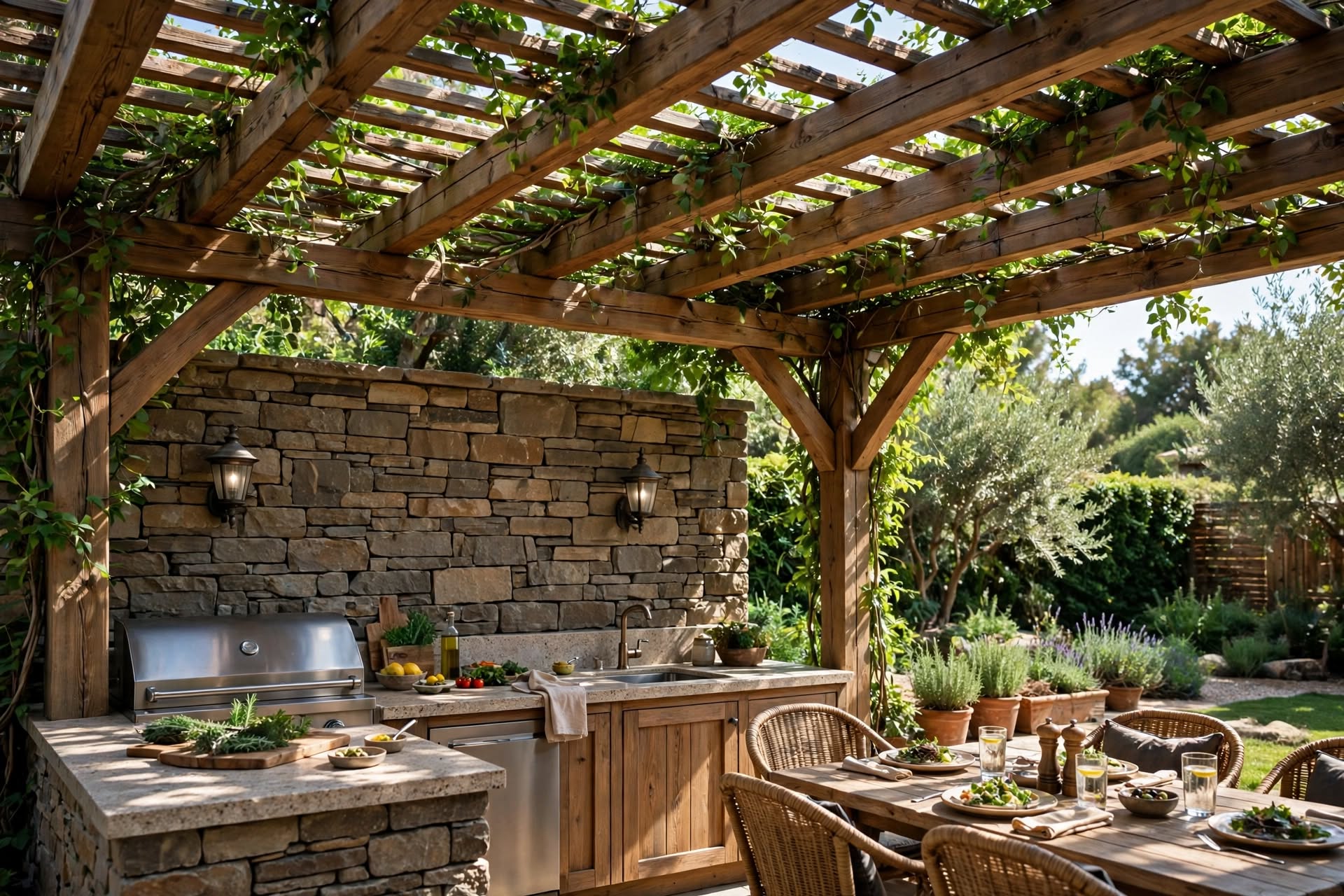

Your indoor oven just filed for emotional damage.
There is a moment when you look at your backyard and realize: I have been underestimating this entire rectangle of grass.
For years, the kitchen has been the heart of the house. The stove lives inside. The refrigerator hums behind closed doors. Cooking happens under a ceiling, surrounded by cabinets, countertops, and appliances. Meanwhile, guests gather in the living room, occasionally wandering into the kitchen to ask when dinner will be ready.
But what if the kitchen could move outside?
Imagine a stone pizza oven glowing beneath a covered pavilion. A long countertop with enough room to prepare food, pour drinks, and set down a plate. Bar stools facing the grill. Warm lights hanging overhead. Beyond the roof, the garden continues into the evening.
An outdoor kitchen is more than a place to cook. It is an opportunity to create another living space — one where preparing dinner, entertaining friends, and enjoying the backyard become part of the same experience.
The best outdoor kitchen ideas are not necessarily the biggest or most expensive. They are the ones that make the space feel natural, comfortable, and connected to the way you actually live.
The Oven That Moved Out
Here is the first paradox: we spent generations improving the indoor kitchen, adding better appliances, ventilation, and increasingly sophisticated equipment. Then we started moving the cooking outdoors.
It makes sense once you understand what an outdoor oven adds to a backyard.
A wood-fired pizza oven creates a natural focal point. Its rounded shape, masonry construction, and visible flame give the kitchen a sense of permanence. It feels less like another appliance and more like the beginning of an outdoor gathering place.
But a pizza oven is only one possibility.
Choose the cooking station that fits your lifestyle
Wood-fired pizza oven
A wood-fired oven is ideal for people who enjoy making pizza, baking flatbreads, and cooking with retained heat. It can become the visual centerpiece of a rustic or Mediterranean-inspired outdoor kitchen.
Built-in gas grill
A built-in grill is a practical choice for regular outdoor cooking. It can be integrated into a countertop run, island, or larger masonry structure, creating a streamlined cooking station.
Charcoal grill
For those who enjoy traditional charcoal cooking, a dedicated grill area can bring a more classic barbecue atmosphere to the backyard. It needs appropriate clearance, ventilation, and a suitable non-combustible installation area.
Combination cooking station
Some outdoor kitchens combine a grill with a pizza oven, side burner, or other cooking equipment. This approach offers flexibility, although it requires more planning, workspace, and room for safe equipment placement.
The important thing is not to install every appliance available. Choose the cooking equipment you will actually use.
A backyard kitchen should make everyday cooking easier, not become an expensive collection of equipment that rarely gets switched on.
The Outdoor Kitchen Layout That Fits Your Backyard
Before choosing countertops or pendant lights, think about the shape of the space.
The layout determines how easily you can move between preparation, cooking, serving, and dining. It also influences how much room remains for seating and circulation.
There are several popular configurations, each with a different character.
1. The Straight-Line Outdoor Kitchen
A straight-line kitchen places the main equipment and work surface along one wall or a single counter run.
<AsyncImage query=”straight line outdoor kitchen along garden wall built in stainless steel grill stone countertop natural wood cabinets” aspectRatio=”16:9″ width=”100%”/>
This is one of the most practical solutions for a narrow patio or a smaller backyard. It keeps the main functions together without occupying the center of the space.
A simple arrangement might include a grill, preparation counter, storage cabinets, and a small sink if suitable plumbing is available.
The advantage is visual simplicity. The kitchen has a clear footprint, leaving more room for a dining table, lounge chairs, or garden planting.
2. The L-Shaped Outdoor Kitchen
<AsyncImage query=”L shaped outdoor kitchen stone countertop built in grill sink modern covered backyard patio” aspectRatio=”16:9″ width=”100%”/>
An L-shaped layout uses two connected counter sections to create a corner cooking area.
One side can accommodate the grill and preparation surface, while the other provides serving space, storage, or a sink.
This arrangement can make a backyard kitchen feel more substantial without requiring a completely separate island. It also helps define the cooking zone within a larger patio.
3. The Outdoor Kitchen Island
<AsyncImage query=”modern outdoor kitchen island with bar stools stone countertop built in grill luxury garden patio” aspectRatio=”16:9″ width=”100%”/>
An island creates a natural meeting point.
Guests can sit on one side while food is prepared on the other. The countertop becomes a place for drinks, serving dishes, and casual conversation.
For a social backyard, this can be one of the most appealing layouts. Just make sure there is enough clearance around the island for people to move comfortably, open appliances, and use the cooking equipment safely.
4. The Covered Outdoor Kitchen Pavilion
<AsyncImage query=”covered outdoor kitchen pavilion stone pizza oven wooden ceiling dining table warm garden lighting” aspectRatio=”16:9″ width=”100%”/>
A pavilion creates the feeling of a separate outdoor room.
It can combine a cooking station, dining area, and comfortable seating beneath one roof. Stone, timber, and natural finishes help the structure blend into the garden.
This option is particularly attractive when the backyard is large enough to accommodate a more permanent outdoor living area.
The roof does not need to turn the space into another indoor room. Its purpose is to provide useful shelter while keeping the garden visible and accessible.
The Roof That Forgot to Be a Wall
We often think of a roof as something that keeps the weather out. But an outdoor kitchen roof has another purpose: it creates a sense of place.
A few structural posts and a roof can transform an ordinary patio into a destination. Suddenly, the dining table has a defined location. The cooking station feels more permanent. Pendant lights have somewhere to hang.
And the garden remains part of the room.
There are several ways to achieve this effect.
Pergola: Shade Without Losing the Open-Air Feeling
<AsyncImage query=”wooden pergola outdoor kitchen natural timber beams climbing greenery backyard dining area” aspectRatio=”16:9″ width=”100%”/>
A pergola is a good choice when you want partial shade and an open connection to the sky.
Traditional open-beam designs allow sunlight to filter through, while climbing plants can introduce greenery and soften the structure.
Some modern pergolas include adjustable louvers or retractable covers, allowing the amount of shade and weather protection to be changed.
However, an open pergola should not be treated as full protection from rain.
Solid-Roof Pavilion: A More Sheltered Outdoor Room
<AsyncImage query=”modern outdoor kitchen pavilion solid timber roof stone countertops grill dining area backyard” aspectRatio=”16:9″ width=”100%”/>
A solid roof creates a more sheltered environment and can make the kitchen more comfortable during changing weather.
It is especially useful when the outdoor kitchen includes a dining table, built-in storage, or appliances that benefit from greater protection.
Roof drainage, structural design, ventilation, and the placement of cooking equipment all need to be considered before construction.
Retractable Canopy: Flexible Protection
<AsyncImage query=”modern retractable canopy over outdoor kitchen patio dining furniture garden” aspectRatio=”16:9″ width=”100%”/>
A retractable canopy offers flexibility. It can provide shade when the sun is strong and open the space when you want more daylight.
It may suit a patio where a permanent pavilion would feel too heavy.
Whichever option you choose, remember that a roof does not automatically make every cooking appliance safe to use beneath it. Grills, pizza ovens, and other heat-producing equipment require suitable clearances, ventilation, and installation according to manufacturer instructions and applicable local regulations.
A beautiful roof should protect the experience, not create a safety problem.
The Fire That Became Furniture
There was a time when fire was simply a tool. Today, in an outdoor living space, it can become the visual center around which everything else is arranged.
The stacked firewood, the textured stone, the warm glow after sunset — all of it contributes to the atmosphere.
But it helps to distinguish between three different elements.
The cooking fire
A pizza oven or grill is designed for preparing food. Its location should be planned around safe operation, working space, and access to fuel or utilities.
The fire pit
A fire pit is primarily a gathering feature. It can create a comfortable seating area, separate from the cooking station, where people can relax after dinner.
The outdoor fireplace
A built-in fireplace can give a pavilion or covered patio a more architectural character. It requires appropriate construction, ventilation, and attention to clearances and local requirements.
<AsyncImage query=”luxury backyard outdoor kitchen separate stone fireplace fire pit lounge seating under pavilion evening” aspectRatio=”16:9″ width=”100%”/>
You do not necessarily need all three.
In many backyards, one well-designed cooking feature and a comfortable seating area are enough. If you want a separate fire pit, place it thoughtfully so that smoke, heat, and circulation do not interfere with the kitchen.
The goal is to make the fire a natural gathering point without allowing it to dominate every part of the layout.
Materials That Can Live Outside
An outdoor kitchen has a harder job than an indoor one.
It must cope with rain, sunlight, temperature changes, moisture, and regular use. Materials that look beautiful in a sheltered interior may not perform well when exposed to outdoor conditions.
This is why material selection should happen before the decorative details.
Natural Stone
<AsyncImage query=”natural stone outdoor kitchen island rustic limestone countertop built in grill garden” aspectRatio=”16:9″ width=”100%”/>
Stone gives an outdoor kitchen a substantial, timeless appearance.
It works especially well with Mediterranean, rustic, and traditional backyard designs. Depending on the type of stone and its finish, it can introduce subtle variations in color and texture.
Choose stone products suitable for the expected exposure and make sure the installation and sealing requirements are understood.
Brick
<AsyncImage query=”traditional red brick outdoor kitchen wood fired pizza oven rustic backyard cooking area” aspectRatio=”16:9″ width=”100%”/>
Brick is a natural choice for kitchens with pizza ovens, fireplaces, and traditional masonry features.
Its warm color gives the space a lived-in character, while its texture pairs beautifully with wood, stone, and metal.
For areas exposed to high temperatures, ordinary decorative brick should not automatically be assumed suitable. Fireboxes and other high-heat components need the appropriate fire-rated materials and construction system.
Concrete
<AsyncImage query=”modern minimalist outdoor kitchen smooth concrete island countertop built in grill backyard” aspectRatio=”16:9″ width=”100%”/>
Concrete works particularly well in contemporary outdoor kitchens.
It can create clean countertops, substantial islands, and simple architectural forms. Its understated appearance also makes it easy to combine with timber, greenery, and stainless steel.
The mix, reinforcement, finish, and protection must be appropriate for outdoor exposure.
Stainless Steel
<AsyncImage query=”modern outdoor kitchen stainless steel grill cabinets countertop luxury patio” aspectRatio=”16:9″ width=”100%”/>
Stainless steel is a practical material for many outdoor kitchen components, especially grills, drawers, and cabinets.
Look for products specifically designed for outdoor use. Different stainless-steel grades have different resistance to corrosion, and exposure to salt, moisture, and cleaning chemicals can affect performance.
Porcelain and Outdoor-Rated Countertop Materials
<AsyncImage query=”contemporary outdoor kitchen porcelain countertop natural stone look outdoor island garden” aspectRatio=”16:9″ width=”100%”/>
Outdoor-rated porcelain surfaces can provide a clean, contemporary finish and a wide range of visual styles.
They are worth considering when you want the appearance of natural stone without choosing an actual stone slab.
Always check the product specifications for outdoor suitability, installation requirements, heat exposure, and maintenance.
The best material palette is usually a combination rather than a single finish. Stone, timber, metal, and greenery can make the kitchen feel connected to the house and garden.
The Details That Make It Feel Like a Second Home
A grill and a countertop create a cooking station. The smaller details turn that station into a place where people want to spend time.
A Bar Counter That Invites Conversation
<AsyncImage query=”outdoor kitchen bar counter wooden bar stools covered patio garden entertaining” aspectRatio=”16:9″ width=”100%”/>
A bar counter is one of the most useful additions to a social outdoor kitchen.
It gives guests somewhere to sit while food is prepared and creates a natural connection between the cooking and dining areas.
Choose outdoor-rated stools with materials suited to your climate. Timber, metal, and woven outdoor furniture can all work well when properly specified and maintained.
Storage That Keeps the Countertops Clear
<AsyncImage query=”built in outdoor kitchen weather resistant storage drawers cabinets stone countertop” aspectRatio=”16:9″ width=”100%”/>
Storage is easy to overlook when planning an outdoor kitchen.
But utensils, serving dishes, cleaning supplies, and cooking accessories need somewhere to go.
Weather-resistant cabinets and drawers can help keep the work surfaces organized. If the kitchen is exposed to rain or humidity, choose storage systems specifically designed for outdoor conditions.
Lighting That Extends the Evening
<AsyncImage query=”outdoor kitchen warm pendant lighting wall sconces under wooden pavilion evening garden” aspectRatio=”16:9″ width=”100%”/>
Lighting should make the kitchen both attractive and usable.
Combine general lighting beneath the roof with task lighting around preparation and cooking surfaces. Softer accent lighting can highlight a stone wall, dining area, or nearby planting.
Use fixtures and electrical installations rated for their actual outdoor location and exposure. Electrical work should follow local requirements and be carried out by a qualified professional where required.
A Dining Area That Belongs to the Kitchen
<AsyncImage query=”outdoor kitchen pavilion large wooden dining table comfortable chairs garden dinner setting” aspectRatio=”16:9″ width=”100%”/>
A dining table does not have to be immediately beside the grill, but it should feel connected to the cooking area.
For larger backyards, a separate dining zone can make the layout more comfortable. In smaller spaces, a compact table or integrated bar counter may be a better solution.
Choose furniture designed for outdoor conditions and leave enough room for chairs to move without blocking access to the kitchen.
Small Outdoor Kitchen Ideas That Make Every Inch Count
Not every backyard has room for a large stone pavilion, a separate dining room, and a full-size cooking island.
Fortunately, a smaller outdoor kitchen can still feel complete.
The secret is to prioritize the essentials.
Start with a compact grill and a useful preparation surface. Add storage underneath rather than spreading cabinets across the patio. Use a narrow counter or a small serving ledge if there is not enough room for a full island.
<AsyncImage query=”small compact outdoor kitchen narrow patio built in grill wood cabinets stone counter potted plants” aspectRatio=”16:9″ width=”100%”/>
A few ideas worth considering:
- Use one clear counter run. Keeping the main equipment along one side can preserve circulation space.
- Choose multifunctional furniture. A serving counter can double as a casual dining spot.
- Use vertical space carefully. Shelves can hold selected accessories, provided they are suitable for outdoor conditions and do not interfere with cooking safety.
- Keep the color palette simple. A limited combination of stone, timber, and greenery can make a compact area feel more cohesive.
- Avoid oversized appliances. Choose equipment according to the number of people you usually cook for.
If the patio is very small, it may be better to create a compact cooking station and a separate comfortable seating area elsewhere in the garden.
A second home does not need a second full-size kitchen.
The Kitchen That Eats Your Calendar
Here is the final surprise, the part no blueprint can fully explain.
An outdoor kitchen changes more than the location of the stove. It changes the way the backyard is used.
Tuesday becomes a reason to grill. A quiet weekend afternoon turns into a long lunch. A few friends arrive for dinner and somehow stay until the garden lights are the only things still visible.
The kitchen becomes a place where cooking and conversation happen together.
Your indoor kitchen asks: What are we making?
Your outdoor kitchen asks: Who is coming?
And that is the difference between owning a yard and creating another place to live.
So build the pavilion if you have room. Choose the stone that belongs in your landscape. Install the grill you will actually use. Add the bar stools, the warm lighting, and a table that makes people want to stay.
You do not need the largest outdoor kitchen in the neighborhood.
You need one that makes an ordinary evening feel worth remembering.
The backyard is ready. And it is hungry.
Frequently Asked Questions
What should an outdoor kitchen include?
A basic outdoor kitchen can include a grill, a weather-appropriate work surface, and storage. Larger designs may add a sink, refrigerator, pizza oven, bar counter, or dining area. The best combination depends on the available space, cooking habits, utilities, and budget.
What is the best layout for a small outdoor kitchen?
A straight-line layout is often a practical starting point for a narrow patio or compact backyard. It keeps the main cooking functions together and leaves more room for movement. An L-shaped design may work when a corner can be used efficiently.
Is a covered outdoor kitchen better than an open one?
A covered kitchen can offer useful protection from sun and some weather, making the space more comfortable. However, the roof must be designed around the cooking equipment, ventilation, drainage, and required clearances. An open kitchen may be simpler and more appropriate for some layouts.
What materials are best for an outdoor kitchen?
Suitable options include outdoor-rated stone, concrete, porcelain, stainless steel, and properly selected masonry materials. The right choice depends on the climate, exposure, maintenance requirements, and intended use. Materials near high-heat appliances must meet the relevant installation specifications.
Can an outdoor kitchen be built on a budget?
Yes. Start with a compact grill, a durable preparation surface, and practical storage. You can add a pavilion, built-in appliances, and decorative features later. A smaller, well-planned kitchen is often more useful than a large space filled with equipment you rarely use.
Does an outdoor kitchen need a roof?
Not necessarily. Some outdoor kitchens work well in open patios. A roof or pergola can provide shade and shelter, but the choice depends on local weather, the equipment, and how frequently the kitchen will be used. Cooking appliances must always be installed and operated according to their safety requirements.